What Is MCP and How Is It Different?
Listen to this article
Before we get technical
Have you ever had a drawer full of remote controls — one for the TV, one for the streaming box, one for the sound bar — and wished you could just use a single remote for everything? That's basically the problem AI runs into when it tries to use outside tools. Every tool speaks its own language, and connecting them requires custom work each time. It's messy and slow. So what if there were one shared set of rules that let any AI talk to any tool, no translation headaches required? That idea has a name, and it's already changing how people build with AI.
What you'll learn
- Define MCP in plain English using a universal remote analogy
- Understand how MCP servers wrap tools in a standard format
- See how MCP differs from traditional APIs at a high level
- Learn what 'protocol' means in this context
We just learned how APIs require custom code for every single connection. Let's meet the newcomer that's trying to simplify all of that. MCP. It stands for Model Context Protocol, and if that sounds intimidating, don't worry — we're going to break it apart word by word. "Model" just means the AI. "Context" means the information and tools the AI needs to do its job. And "protocol"? That's a shared set of rules for how two things communicate. Think of how traffic lights work. Red means stop, green means go. Every driver knows the rules, so everyone can navigate the same intersections without chaos. MCP is that kind of agreement, but for AI and tools.
Why does this matter? Remember how we talked about APIs being like a waiter taking your order to the kitchen? Each API is a different waiter at a different restaurant, with a different menu, a different ordering system, and a different way of telling you when your food's ready. If your AI needs to work with fifty tools, you're dealing with fifty different waiters who all speak different languages. MCP replaces all of that with one universal language. One set of rules that every tool and every AI agrees to follow. Instead of fifty custom integrations, you build one connection pattern and reuse it everywhere.
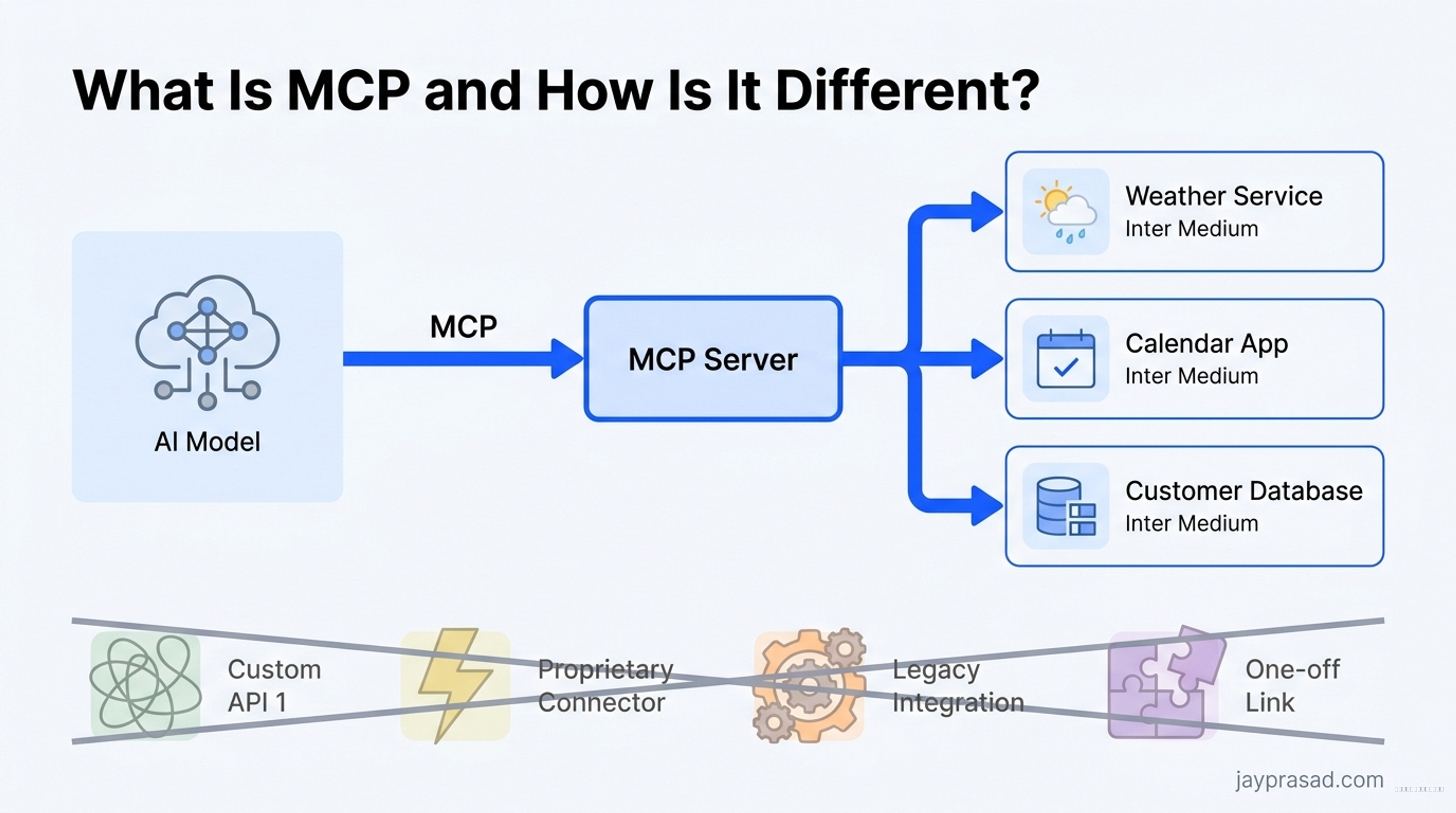
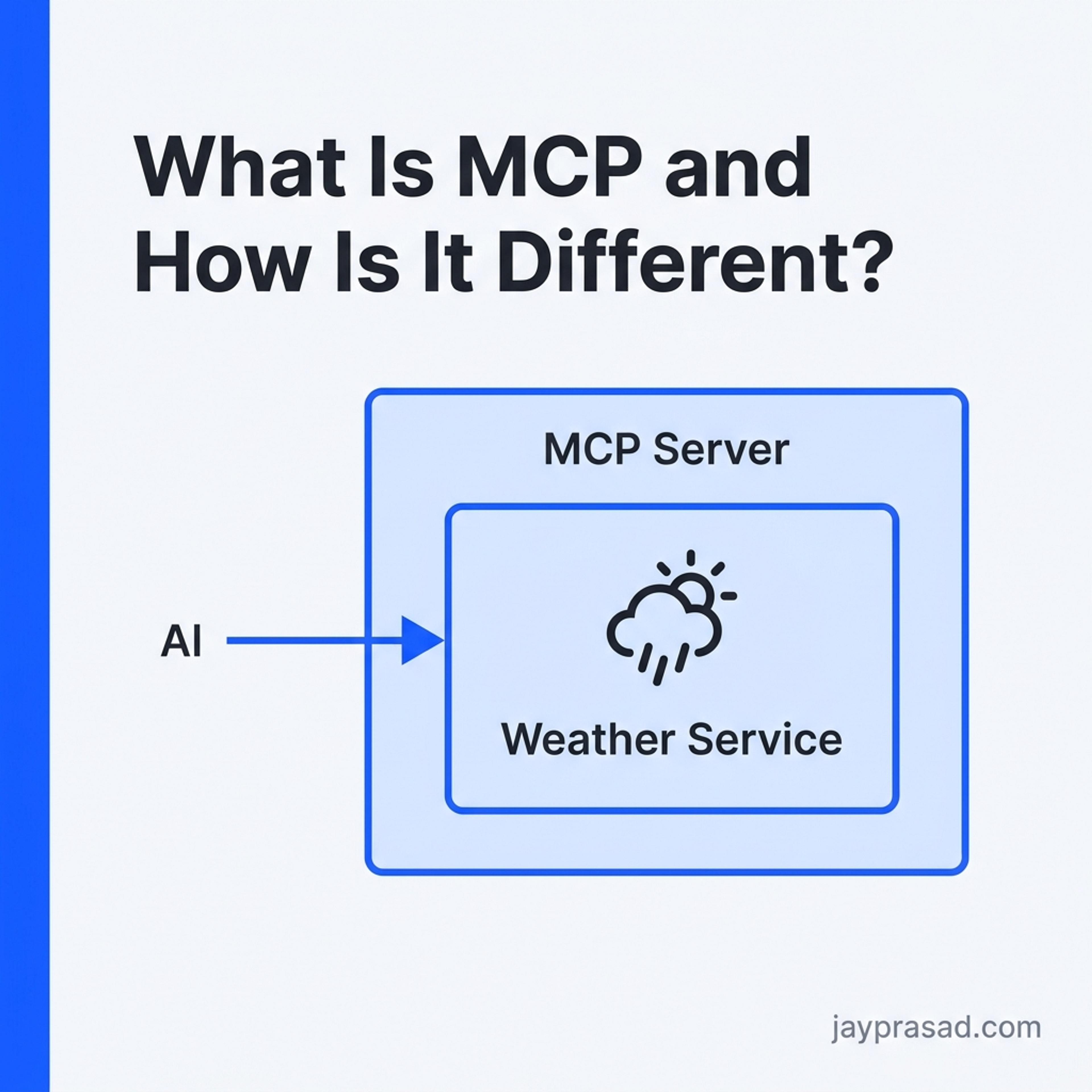
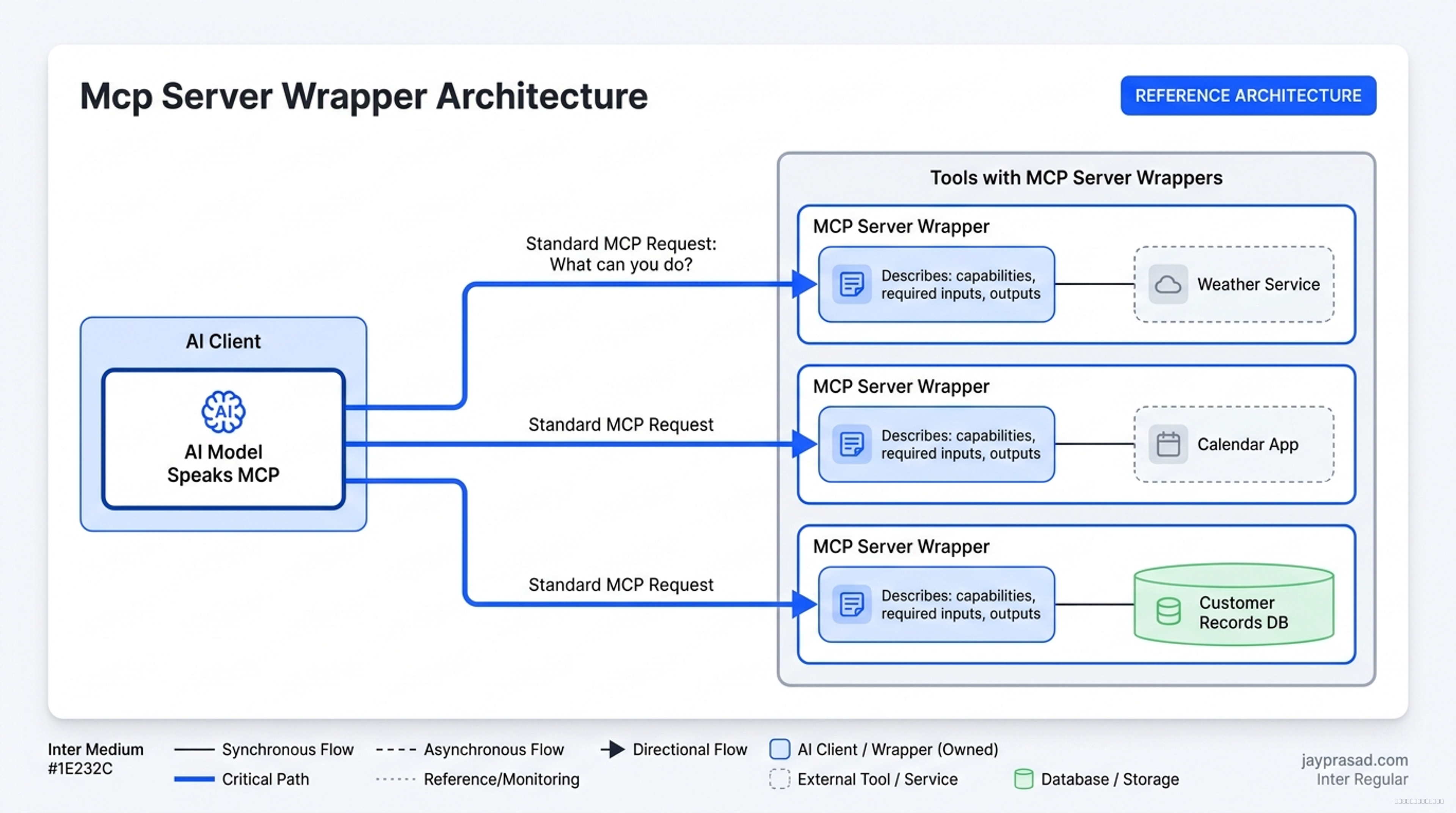
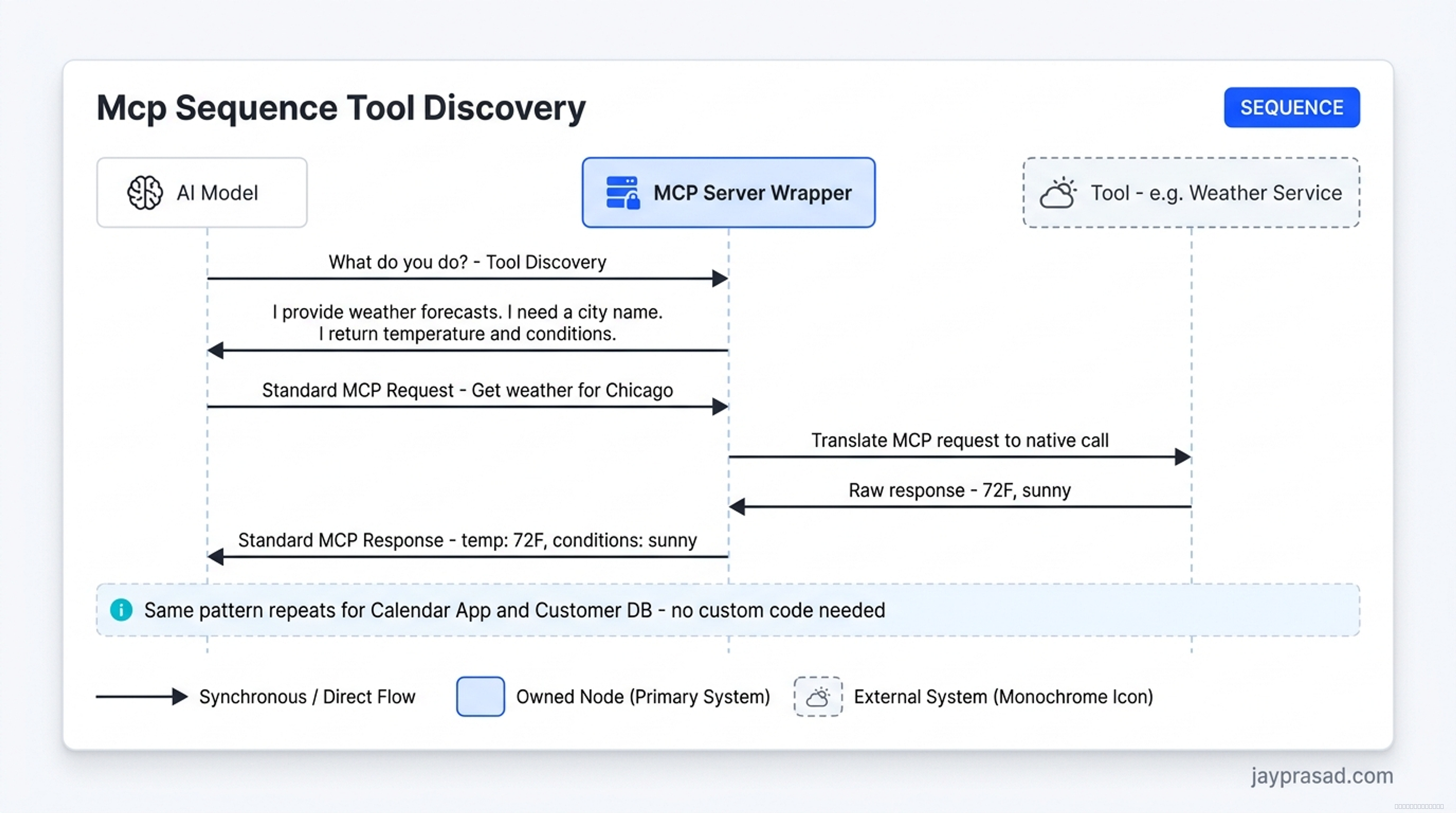
Here's how it actually works. MCP introduces something called an MCP server. Don't let the word "server" scare you — it's just a small wrapper, a thin layer of code that sits around any tool and translates what that tool can do into the standard MCP format. Imagine you have a weather service, a calendar app, and a database full of customer records. Each one gets its own tiny MCP server wrapped around it. That wrapper describes what the tool does, what information it needs, and what it gives back. All in the same consistent format. The AI doesn't need to learn three different systems. It just speaks MCP, and every tool speaks it back.
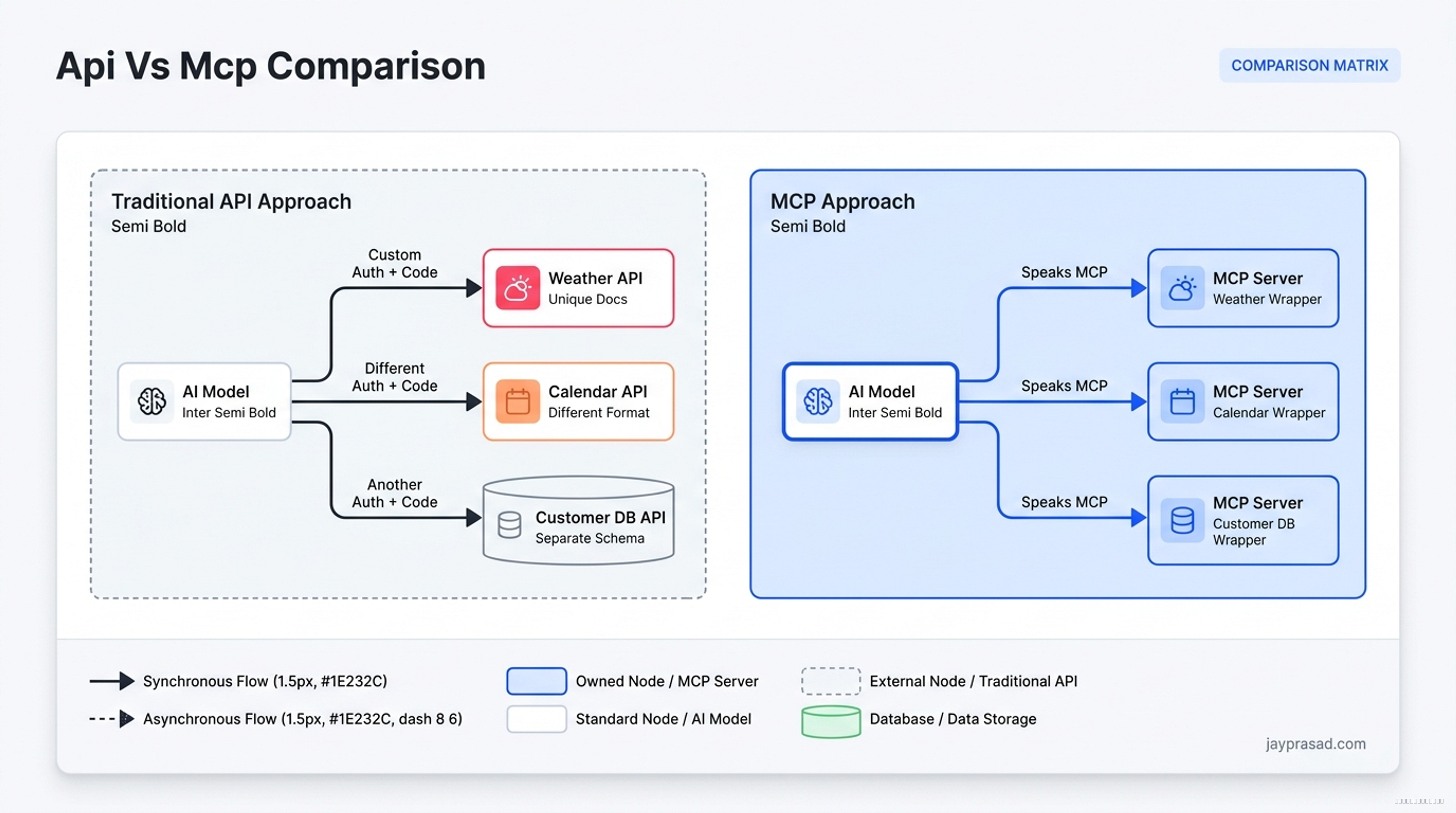
This is a real departure from the traditional API approach we covered earlier. With APIs, a developer has to read each service's unique documentation, write custom code to connect to it, handle each service's specific authentication — API keys, tokens, all of it — and manage every integration separately. With MCP, the format is standardized. The AI knows exactly how to ask questions and exactly what shape the answers will come in, whether it's talking to a weather tool, a spreadsheet, or a code repository. It's the difference between owning thirty different chargers for thirty different devices versus having one universal adapter that works with all of them.
You might be wondering — if MCP is so great, why hasn't everyone switched already? Fair question. MCP is still relatively new, and the ecosystem is growing. But the reason people are genuinely excited is that standardization unlocks something big. When every tool describes itself the same way, the AI doesn't just connect to tools. It can start to understand what tools are available without a human manually setting up each one. That concept has a name, and it changes everything about how we think about AI and tools working together.
MCP sounds great on paper. But the real magic is something called tool discovery, where your AI can find tools it's never seen before and figure out how to use them on its own. How does that actually work?
Coming up next
MCP sounds great on paper. But the real magic is something called tool discovery, where your AI can find tools it's never seen before and figure out how to use them. Let's see how that works.