Cleaning Your Data in the Silver Layer
Listen to this article
What you'll learn
- Understand the purpose of the Silver layer in the Medallion Architecture
- Learn common data quality problems and how to fix them
- See how transformations standardize dates, names, and categories
- Know how data validation rules catch errors before they spread
Last chapter, we created Golden IDs to stitch records together across systems. But linked data isn't the same as clean data. Let's fix that.
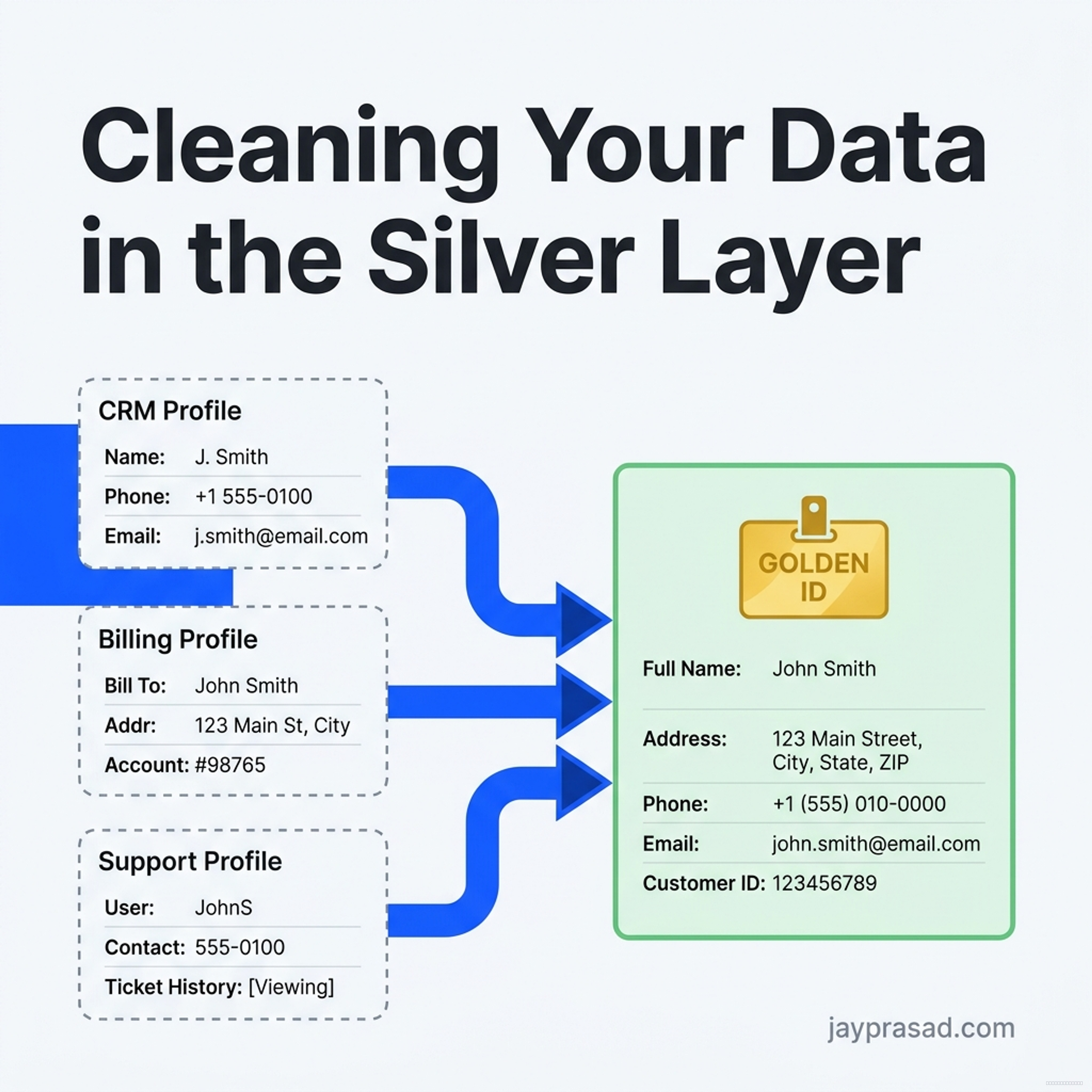
Think about it this way. You might know that three different records all belong to the same customer — that's what the Golden ID gave us, a universal unique identifier connecting a person or company across every system. But if one record says their name is "JOHN SMITH" in all caps, another says "john smith" in lowercase, and a third has their birthday listed as "not available," you've got linked garbage. The Silver layer is where we turn linked garbage into something trustworthy.
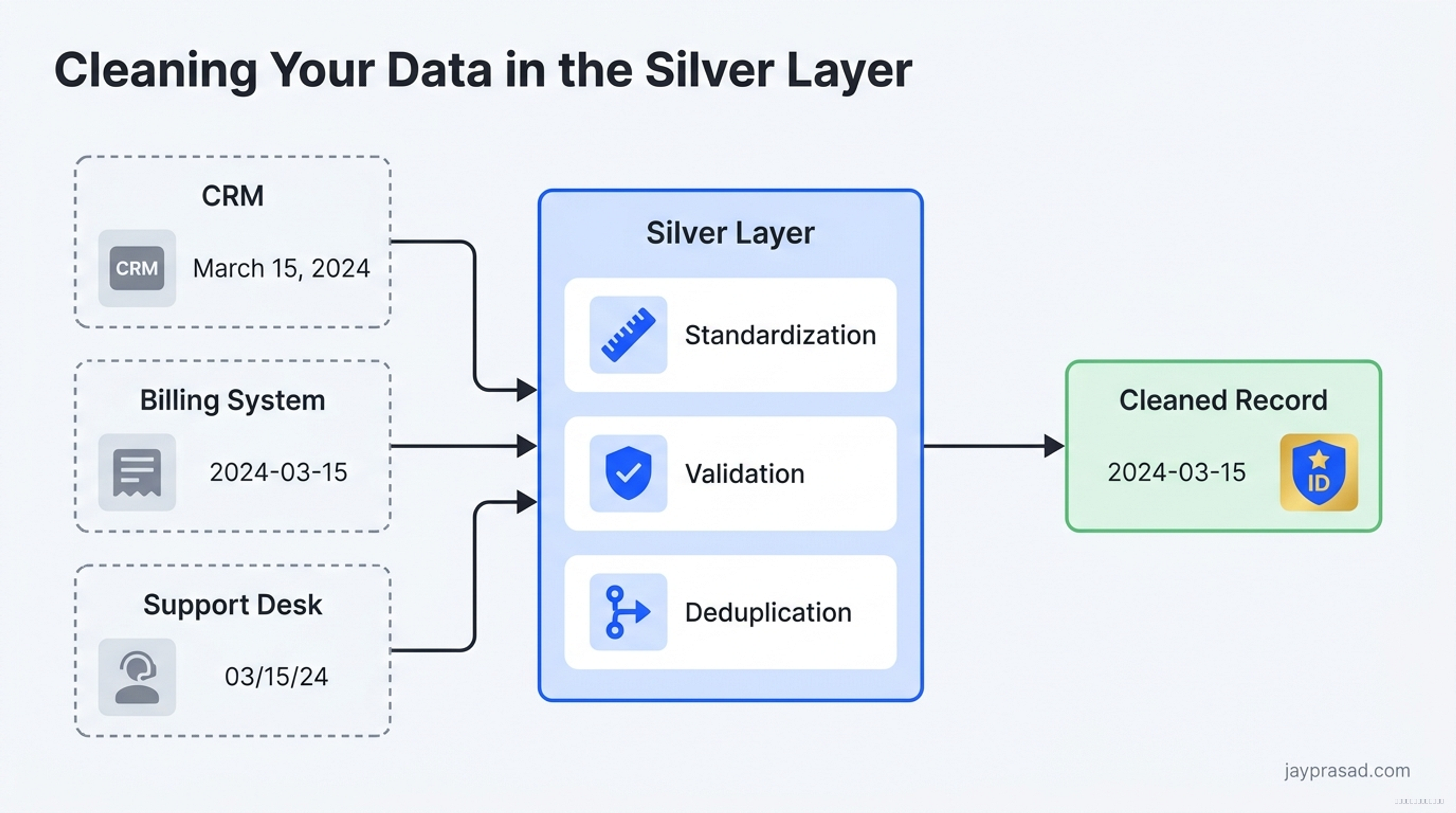
What exactly is the Silver layer? Remember the Medallion Architecture, that three-tier system where data moves from Bronze to Silver to Gold? The Bronze layer we built earlier is just a raw landing zone — everything gets dumped in exactly as it arrived, messy formatting and all. The Silver layer sits in the middle, and its entire job is cleaning, validating, and standardizing that raw data. Think of it like a quality inspection station on a factory floor. Every record passes through, gets checked, gets fixed if possible, and gets flagged or rejected if it can't be saved.
The first big task is standardization — making sure the same type of information looks the same everywhere. Dates are a perfect example. Your CRM might store dates as "March 15, 2024." Your billing system writes "2024-03-15." Your marketing platform uses "03/15/24." Three different formats, all meaning the same thing. In the Silver layer, you pick one standard format and convert everything to match. You do the same for names, phone numbers, addresses, currency values — anything that humans or different software systems might format differently. This matters because when an AI agent eventually reads this data, it needs consistency. It can't reason properly if the same concept looks ten different ways.
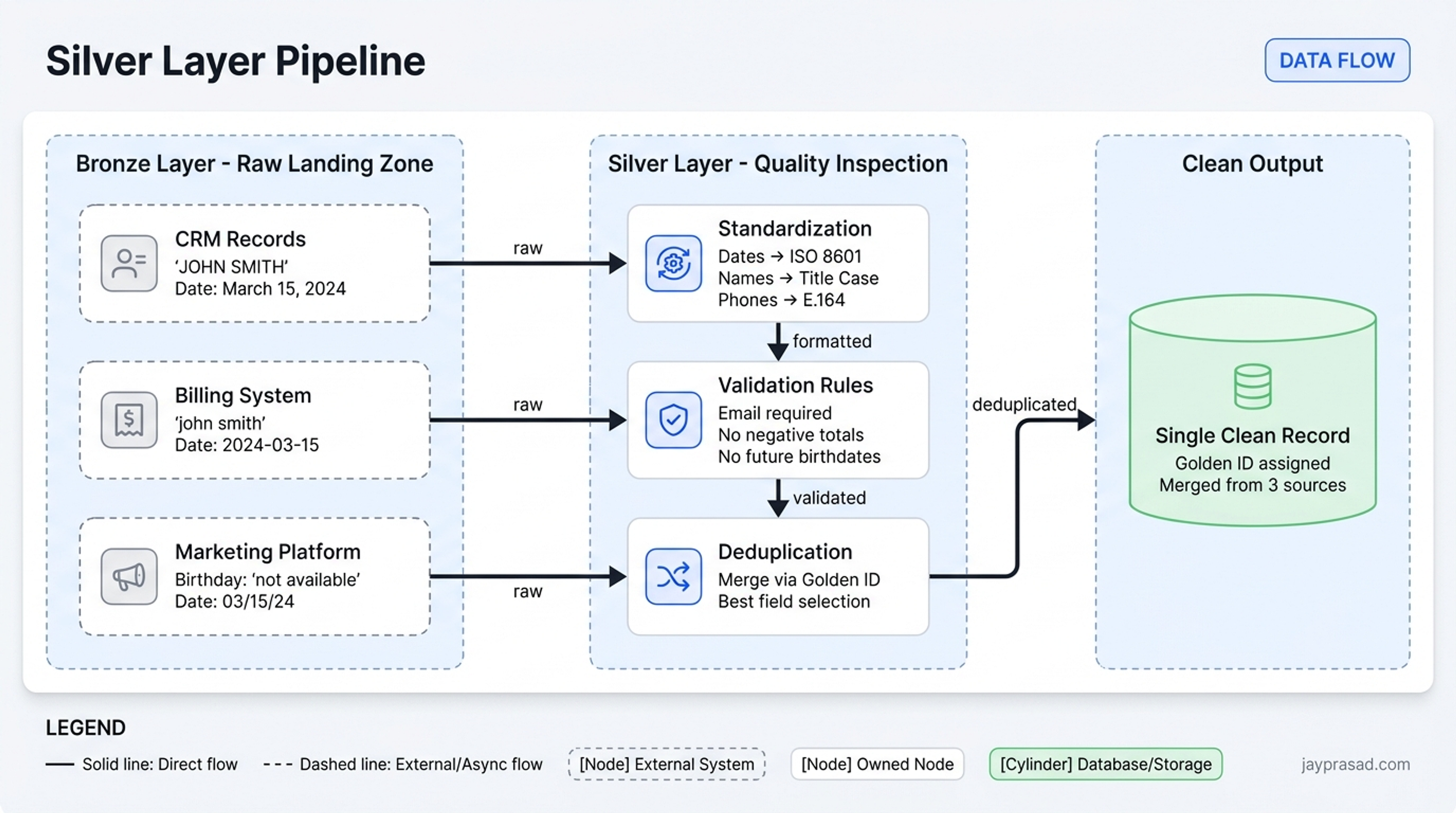
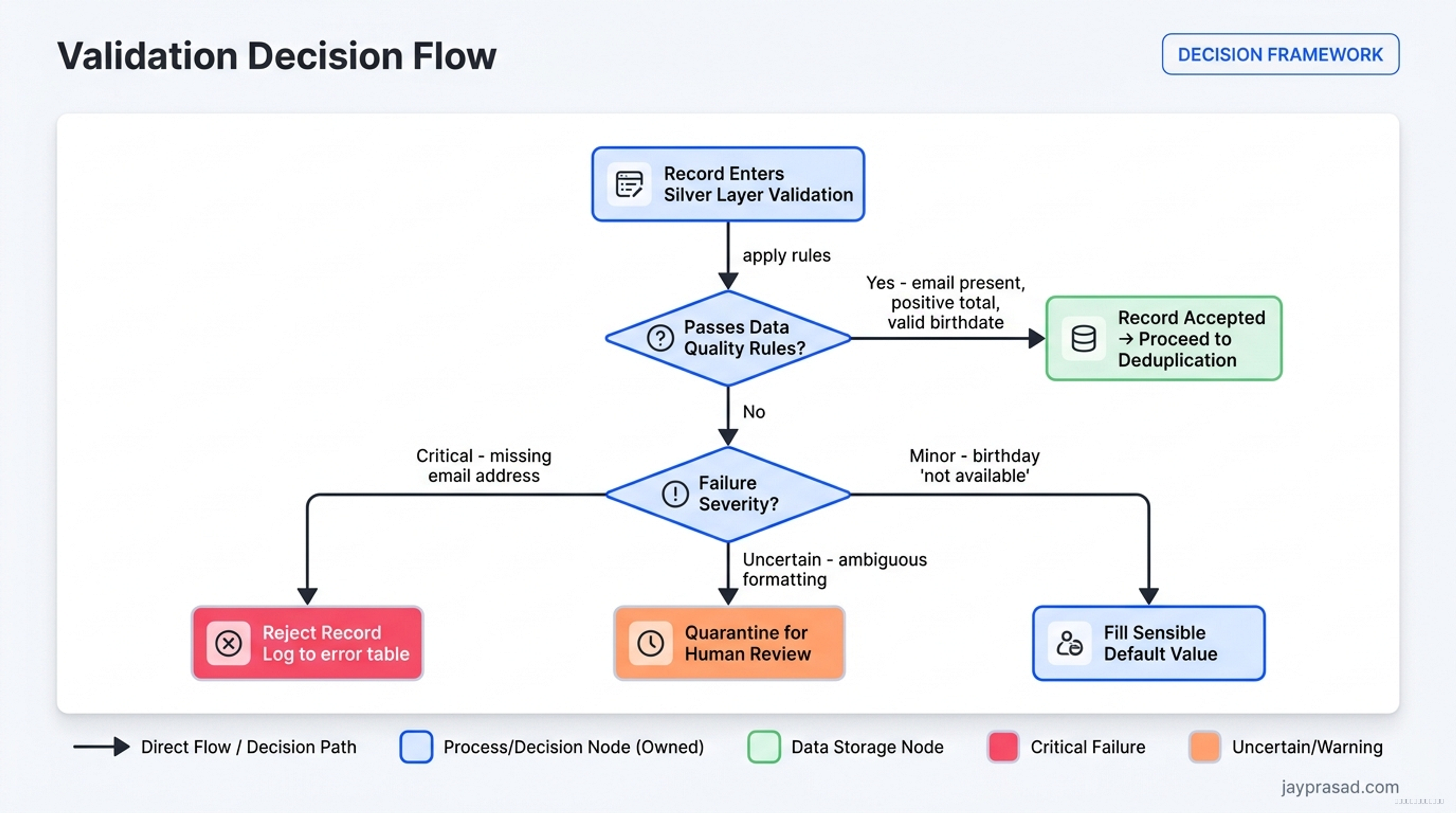
Then there's validation — applying data quality rules to catch errors before they spread downstream. A data quality rule is just a test that each record has to pass. Every customer must have an email address. No order total can be negative. A birthdate can't be in the future. When a record fails one of these checks, you've got options: reject it entirely, send it to a quarantine area for a human to review, or fill in a sensible default value. The point is that bad data gets caught here, not later when an AI agent is trying to make a decision with it. Remember from our very first chapter — AI agents fail without a solid data foundation. This is where that foundation gets its structural integrity.
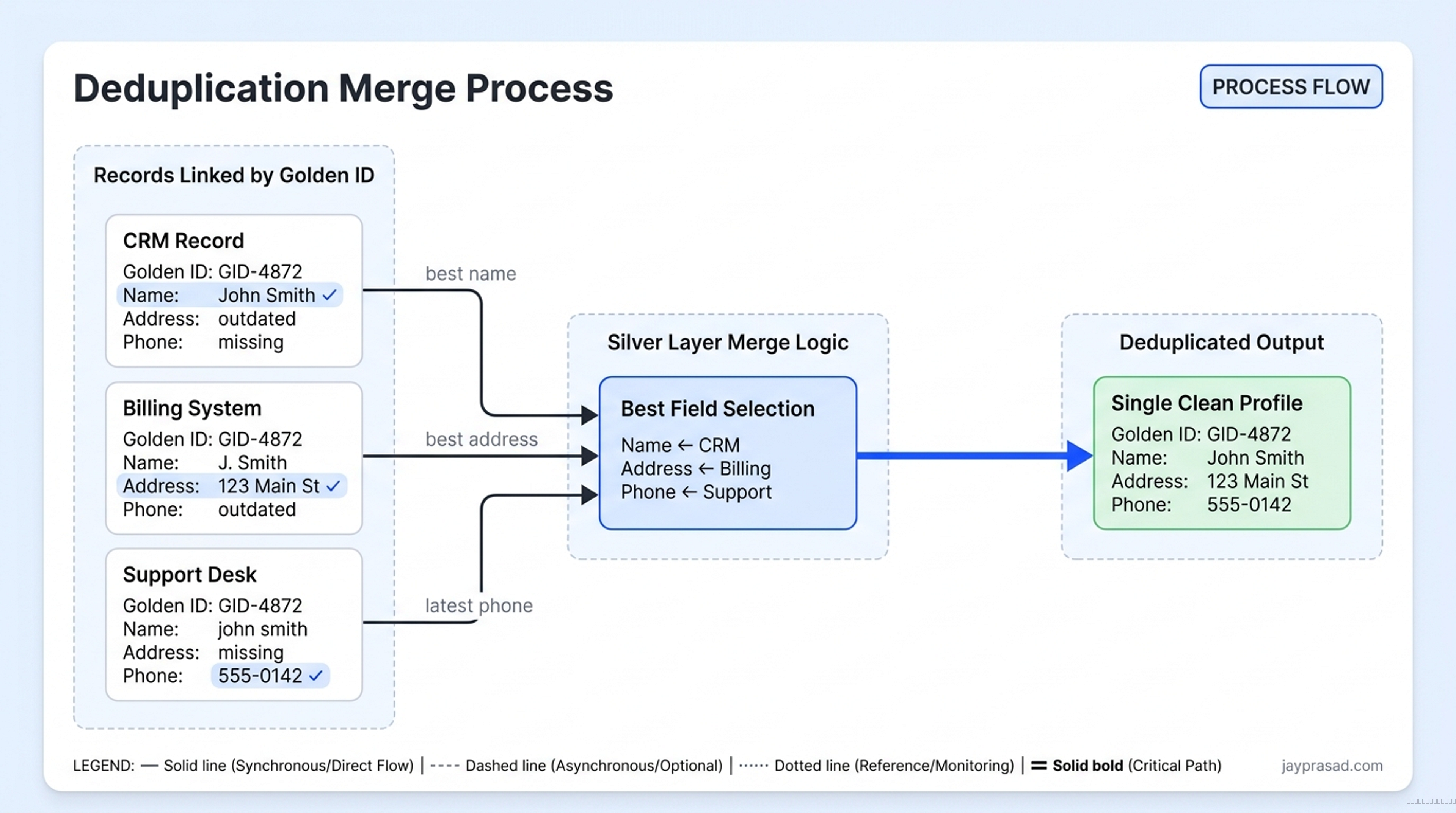
Deduplication. That's the third major task, and it's where the Golden ID from the previous chapter really shines. Because you already know which records across your CRM, your support desk, and your billing system all belong to the same person, you can merge them into a single clean record. Instead of three partial profiles, you get one complete profile with the best available data from each source. Maybe the CRM has the most accurate name, the billing system has the correct address, and the support desk has the latest phone number. The Silver layer combines them intelligently, keeping the most reliable version of each field.
Your data is clean and linked — but can an AI agent just read a giant cleaned-up table and know what to do? Not really. It needs data shaped for specific tasks, pre-arranged into tables designed to answer particular business questions or drive particular workflows. That's what the Gold layer is for, and it's where everything we've built so far finally comes together into something an AI agent can act on.
Coming up next
Your data is clean and linked. But an AI agent can't just read a giant cleaned-up table and know what to do. It needs data shaped for specific tasks. That's what the Gold layer is for.