What Every Agent Runtime Should Share
Triggers, validation, recovery, and auditability belong in the scaffold, not re-invented agent by agent.
Build note
An implementation-focused observation from the engineering layer.
Triggers, validation, recovery, and auditability belong in the scaffold, not re-invented agent by agent.
Execution discipline should live in the runtime, not in individual agents.
Validation, retries, and auditability are operating requirements.
Shared scaffolds reduce entropy and increase shipping speed.
Watch the video
What Every Agent Runtime Should Share
The fastest way to create chaos with agents is to let every team define execution differently. One agent retries quietly, another fails hard, a third writes malformed output, and a fourth has no audit trail at all.
I've watched this pattern destroy enterprise AI initiatives. A financial services client deployed 12 different agent teams last year. By Q3, they had 12 different retry strategies, 12 different logging formats, and zero ability to debug cross-agent workflows. Their mean time to resolution for production issues went from hours to days.
The solution isn't standardizing the agents themselves. It's standardizing the runtime layer that executes them.
The Core Runtime Components Every Agent Needs
When I evaluate agent platforms like LangGraph, CrewAI, or AutoGen, I look for five non-negotiable runtime capabilities. These aren't nice-to-have features. They're the difference between a proof of concept and a production system.
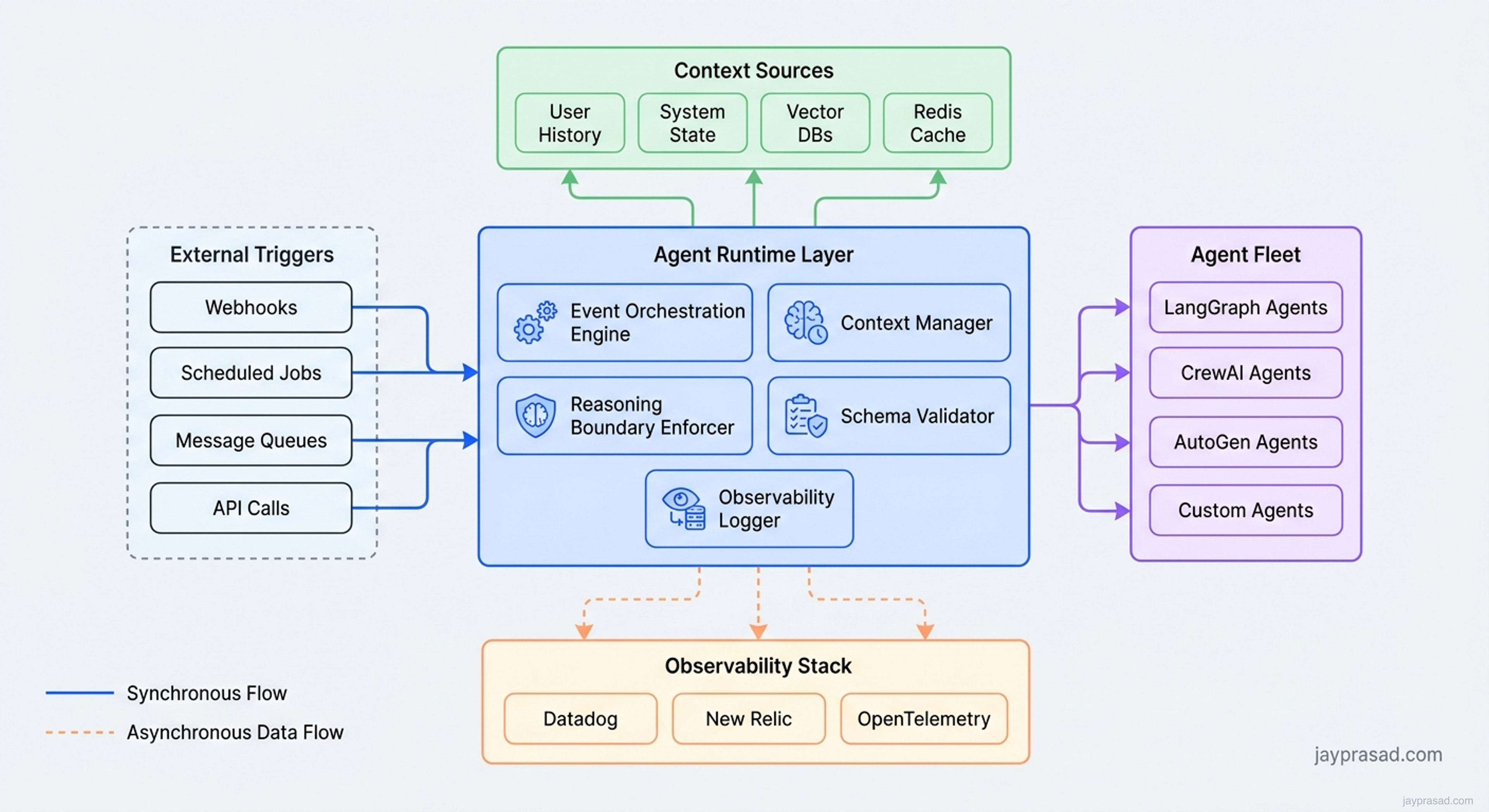
Event Triggers and Orchestration: Your runtime needs to handle webhooks, scheduled jobs, message queues, and API calls uniformly. I've seen teams wire up agents directly to Kafka topics or Lambda functions, only to realize they've created 20 different invocation patterns across their fleet. A proper runtime abstracts this. Microsoft's Semantic Kernel does this well with its connector model. AWS Bedrock Agents provides native EventBridge integration. Both approaches beat rolling your own.
Context Loading and Injection: Every agent needs context, whether that's user history, system state, or retrieved documents. The runtime should own how this context gets loaded, cached, and injected into prompts. I keep seeing teams hardcode context retrieval inside agent logic. That's a mistake. When you need to switch from Pinecone to Weaviate, or add Redis caching, you shouldn't touch agent code.
Reasoning Boundaries: This is where most homegrown solutions fail. Your runtime needs to enforce token limits, timeout policies, and depth restrictions on recursive reasoning. Claude might be brilliant, but if an agent can chain 50 reasoning steps without limits, you'll burn through your budget before lunch. Good runtimes enforce boundaries at the framework level, not through developer discipline.
Schema Validation: LLMs produce text. Your downstream systems expect structured data. The runtime must bridge this gap with ironclad validation. I'm talking Pydantic models, JSON Schema validation, or protocol buffers. Not "we'll parse it and hope for the best."
Outcome Logging and Observability: Which model version ran? What was the exact prompt? Which tools were invoked? What was the confidence score? If you can't answer these questions for any agent execution, you're not ready for production. The runtime should emit structured logs that feed into your observability stack, whether that's Datadog, New Relic, or OpenTelemetry.
Why Shared Operational Scaffolding Beats Team Autonomy
I used to believe in maximum team autonomy. Let each team pick their tools, define their patterns, innovate freely. That philosophy works for many domains. It fails catastrophically for agent systems.
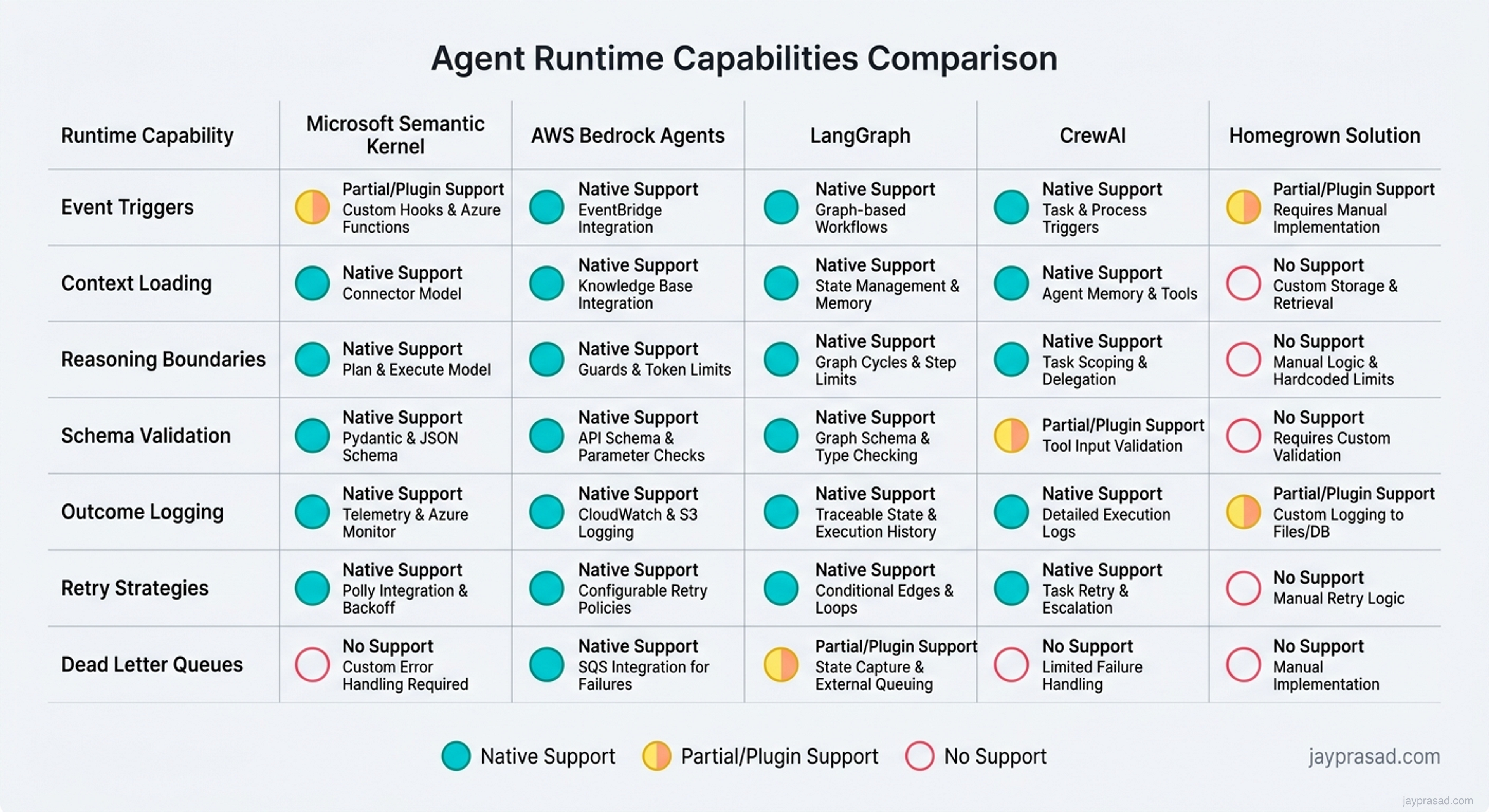
Here's what actually happens when teams build agents independently:
The payments team implements exponential backoff with jitter for retries. The customer service team uses fixed 3-second delays. The fraud detection team doesn't retry at all because "failures need immediate human review." The inventory team retries indefinitely until success. Now try to debug why your end-to-end order processing workflow occasionally takes 45 minutes.
A reusable runtime enforces operational consistency without constraining agent logic. Teams can still innovate on prompts, tools, and workflows. But retry behavior, timeout handling, and error propagation follow platform standards.
Consider dead-letter queue handling. In a shared runtime, every failed agent execution lands in the same DLQ with consistent metadata. You can build unified recovery workflows, aggregate failure patterns, and implement circuit breakers that work across all agents. Try doing that when each team has their own failure handling logic buried in Lambda functions.
The Architecture Patterns That Actually Scale
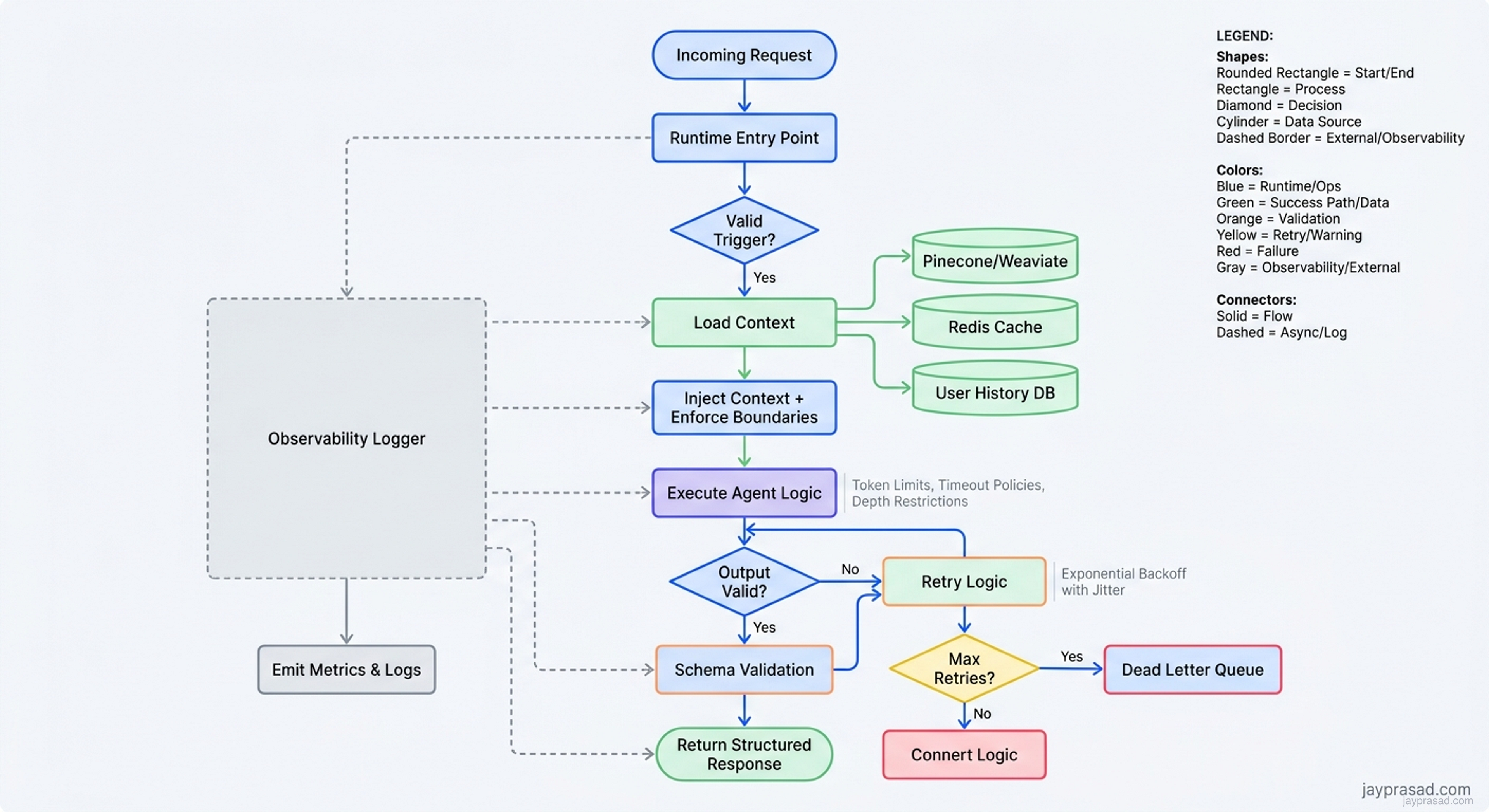
I've implemented agent runtimes at three different scales: startup (5-10 agents), growth stage (50-100 agents), and enterprise (500+ agents). The patterns that work change dramatically with scale.
| Scale | Architecture Pattern | Key Tools | Primary Challenge |
|---|---|---|---|
| Startup | Monolithic Runtime | LangChain + FastAPI | Feature velocity |
| Growth | Service Mesh | LangGraph + Temporal | Operational complexity |
| Enterprise | Platform Runtime | Custom + Kubernetes Operators | Governance and compliance |
At startup scale, a single Python service running LangChain or LlamaIndex can handle your entire agent fleet. You want maximum iteration speed. I recommend starting with LangGraph's built-in runtime and adding custom middleware for logging and validation.
At growth stage, you need workflow orchestration. Temporal or Airflow become critical. Your runtime transforms from a library to a service mesh. Agents become stateless workers. The runtime handles state management, retry logic, and failure recovery. Netflix's Conductor is another solid choice here.
At enterprise scale, you're building a platform. Think Kubernetes operators that manage agent lifecycles, dedicated control planes for governance, and multi-tenant isolation. Google's Vertex AI Agent Builder and AWS Bedrock provide blueprints, but you'll likely need significant customization.
Building Trust Through Output Discipline
The number one reason enterprises don't trust agent systems? Inconsistent outputs. I consulted for a logistics company where agents would return delivery estimates as "2-3 days", "48 hours", "by Thursday", or sometimes just "soon." Their downstream systems expected an ISO 8601 timestamp.
Output discipline starts with the runtime. Every agent response should pass through three layers:
- Structural Validation: Does the response match the expected schema? Use Pydantic or JSON Schema. Reject malformed outputs before they propagate.
- Semantic Validation: Does the response make business sense? A delivery date in the past should fail validation. A price of -$50 should fail validation. Build these rules into your runtime.
- Confidence Scoring: How certain is the agent about this output? The runtime should attach confidence metadata to every response. Downstream systems can then decide whether to act automatically or escalate to humans.
I implement this pattern using a validation pipeline. Here's what works:
Raw LLM Output → Parser → Schema Validator → Business Rules → Confidence Scorer → Structured ResponseTools like Guardrails AI and NeMo Guardrails can help, but I prefer building custom validators that understand your domain. The runtime should make it trivial to add new validation rules without touching agent code.
Audit Trails and Time Travel Debugging
When an agent makes a million-dollar pricing error at 3 AM, you need to reconstruct exactly what happened. Not just the outcome, but the entire execution context.
Your runtime should capture:
- Prompt template version
- Model name and version
- Temperature and other parameters
- Full prompt after variable substitution
- Raw model response
- Tool calls with parameters and results
- Validation outcomes
- Final structured output
Store this in a queryable format. I use PostgreSQL with JSONB columns for flexibility, though ClickHouse or BigQuery work well at scale. The key is making historical executions searchable. "Show me all agents that called the pricing_tool with amounts over $10,000 in the last week" should be a trivial query.
LangSmith and Weights & Biases provide commercial solutions. But I've found custom audit trails give better control over retention, privacy, and integration with existing compliance systems.
What This Means for Platform Teams
If you're running more than 10 agents in production, you need a platform team owning the runtime layer. Not a framework team building abstractions. Not an infrastructure team managing compute. A platform team that understands both agent development patterns and operational excellence.
This team should own:
- Runtime feature roadmap based on agent team needs
- SLAs for latency, availability, and throughput
- Security boundaries and access controls
- Cost optimization and resource allocation
- Migration paths for new models and frameworks
Start by instrumenting your existing agents. How many different retry patterns exist? How many logging formats? How many ways to invoke an agent? That inventory becomes your migration roadmap.
Then pick your battles. You won't migrate everything overnight. Start with new agents using the shared runtime. Migrate existing agents during their next major update. Use feature flags to gradually roll out runtime capabilities.
The payoff comes quickly. I've seen teams ship new agents 3x faster once they stop reimplementing operational scaffolding. Debugging becomes tractable when every execution follows the same patterns. Cost optimization becomes possible when you have unified resource management.
Most importantly, trust in the system grows. When every agent behaves predictably at the operational layer, teams can focus on making them smarter, not just more reliable. That's when agent systems transform from interesting demos to critical business infrastructure.
Discussion
Responses, reactions, and open questions.
The article stays static. The conversation sits underneath it. Sign in with your email, react to the argument, and join the discussion.
Join the discussion
Use your email to get a one-time sign-in code. First comments may wait in moderation before they appear publicly.
Continue reading