The "Queryable Company" Is a Data Architecture Problem, Not a Startup Superpower
The competitive edge in building AI-native isn't being a startup, it's having intentional data architecture from day one, a discipline most founders lack.
Core argument
The short version of the piece before you go deeper.
The competitive edge in building AI-native isn't being a startup, it's having intentional data architecture from day one, a discipline most founders lack.
Watch the video
The "Queryable Company" Is a Data Architecture Problem, Not a Startup Superpower
# The "Queryable Company" Is a Data Architecture Problem, Not a Startup Superpower
There's a provocative claim making the rounds in the startup world: the highest-leverage move for a new company isn't adopting AI tools. It's architecting the entire organization as an AI-native system from day one. Every business process queryable. Every decision artifact machine-readable. Middle management replaced by an "intelligence layer." Individual engineers operating at 1,000x throughput.
It's a compelling vision. It's also an incomplete engineering spec.
The concept of the queryable company, where AI agents can reason over the full state of the business, is the most architecturally interesting idea in this whole conversation. But the gap between "make your company queryable" and actually doing it is filled with the same enterprise data architecture problems that have humbled organizations for decades: schema design, event-driven architectures, data contracts, governance models, and trust boundaries.
The real competitive edge isn't being a startup. It's having intentional data architecture from day one. Most founders don't have that discipline.
---
What "Queryable" Actually Means in Engineering Terms
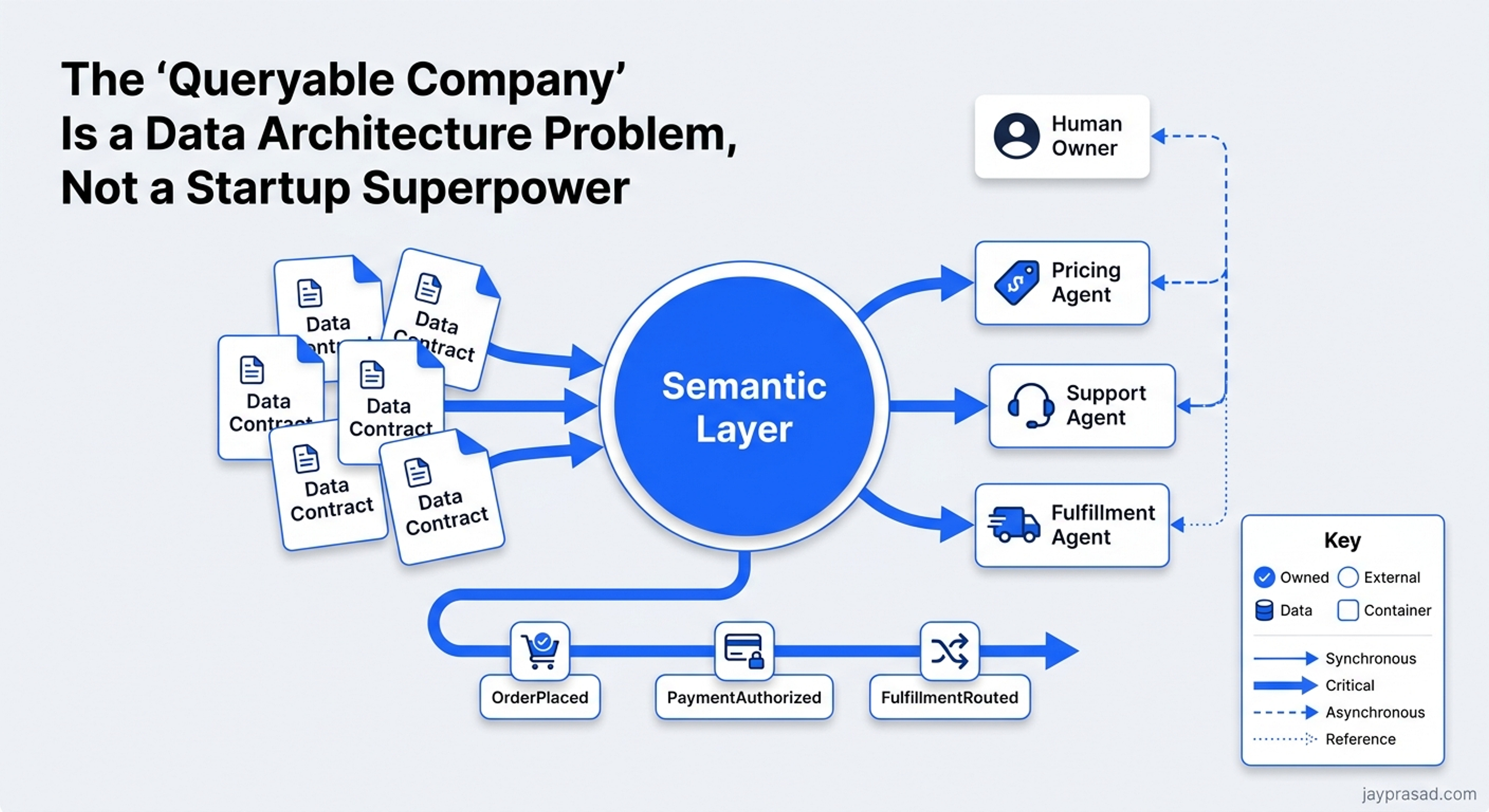
When proponents say a company should be "fully queryable so agents can improve across every function," they're describing something specific whether they name it or not: a semantic layer over the entire organization's operational data, exposed through well-defined APIs, with enough structure that an AI agent can reason about business state without human translation.
This maps onto three established enterprise patterns.
Semantic Layers
A semantic layer translates raw data into shared business meaning. When an AI agent asks "what's our customer acquisition cost by channel this quarter," it shouldn't need to know which tables to join or how marketing_spend is calculated across three different systems. The semantic layer handles that abstraction.
Tools like dbt Semantic Layer, Cube, or AtScale have been solving this for analytics. The AI-native version extends it to operational queries, not just "what happened" but "what should happen next."
Event Sourcing
In an event-sourced architecture, every state change gets captured as an immutable event. This gives AI agents a complete, auditable history to reason over. Not just current state, but the full sequence of decisions that produced it.
# Example: Order lifecycle as event stream
events:
  - type: OrderPlaced
    timestamp: 2025-01-15T10:23:00Z
    payload:
      order_id: "ORD-9182"
      customer_id: "CUST-4421"
      items: [{ sku: "WDG-100", qty: 2 }]

  - type: PaymentAuthorized
    timestamp: 2025-01-15T10:23:04Z
    payload:
      order_id: "ORD-9182"
      auth_code: "AUTH-8827"

  - type: FulfillmentRouted
    timestamp: 2025-01-15T10:23:05Z
    payload:
      order_id: "ORD-9182"
      warehouse: "US-WEST-2"
      agent_decision_id: "AGT-D-11042"
That agent_decision_id field matters. A lot. When an AI agent makes a routing decision, the event log captures which agent, what inputs it considered, and what it decided. This is the foundation of agentic auditability, and it's non-negotiable for any company that expects to operate under regulatory scrutiny.
Data Contracts
A data contract is a formal agreement between a data producer and consumer about schema, quality, and SLAs. In an AI-native company, every internal service needs to publish a data contract that agents can discover and rely on.
# data-contract: customer-profile-v2
schema:
  customer_id: { type: string, required: true }
  ltv_segment: { type: enum, values: [high, mid, low] }
  last_interaction: { type: datetime, freshness: "< 1h" }
sla:
  availability: 99.9%
  latency_p99: 200ms
owner: customer-platform-team
consumers: [pricing-agent, support-agent, retention-agent]
Without data contracts, your "queryable company" is a house of cards. Agents will make decisions on stale data, misinterpret field semantics, and produce outputs that look plausible but are wrong. That's the trap.
Here's the uncomfortable truth: Most startups are just as bad at data architecture discipline as the enterprises they aim to disrupt. The competitive asymmetry isn't startup-versus-incumbent. It's intentional-data-architecture-from-day-one versus retroactive cleanup. That distinction cuts across company size.
---
The Architecture Stack: AI-Native vs. AI-Adopted
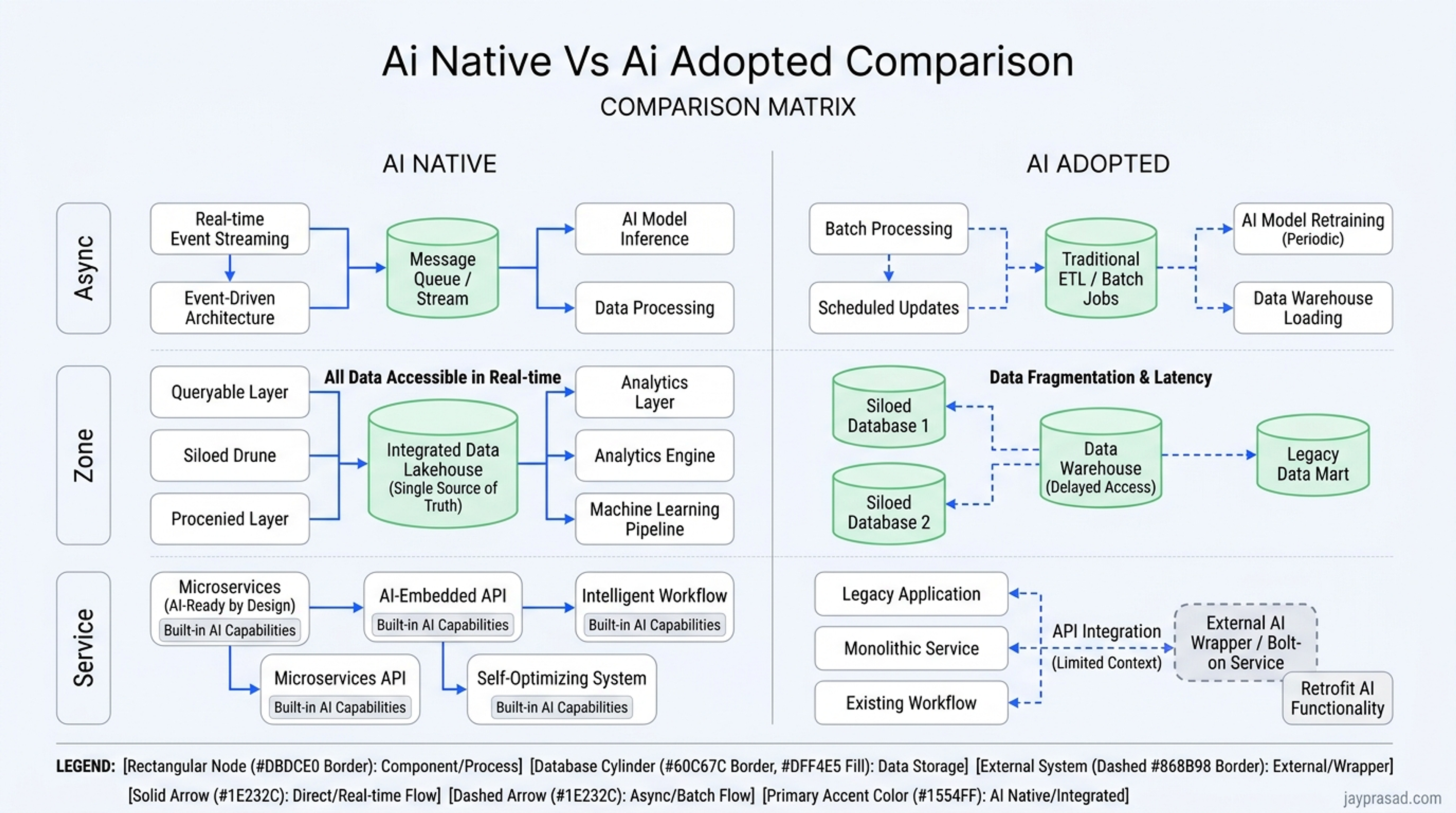
The difference between building AI-native and bolting AI onto existing systems isn't cosmetic. It's structural.
| Dimension | AI-Adopted (Retrofit) | AI-Native (Greenfield) |
|---|---|---|
| Data capture | Batch ETL from siloed systems | Event-sourced from inception |
| Agent access | Screen-scraping, CSV exports | Typed APIs with data contracts |
| Decision audit | Manual logs, tribal knowledge | Immutable event streams |
| Schema governance | Afterthought | First-class product |
| Trust boundaries | Implicit (org chart) | Explicit (agent permission scopes) |
| Coordination model | Human middleware (meetings, Slack) | Agentic workflows with escalation rules |
The retrofit path is where most enterprises live today. They've got decades of operational data locked in systems that were never designed to be queried by autonomous agents. The greenfield path is what the AI-native vision describes, but it requires engineering discipline that the startup world chronically underestimates.
---
Middle Management Doesn't Disappear. It Gets Redesigned.
The claim that "management hierarchies break down when an intelligence layer replaces human middleware" is the most provocative and least defensible part of the argument.
Middle management serves at least four functions:
- Information routing, aggregating signals from teams and passing them up/down the hierarchy
- Context translation, interpreting what a data pattern means for strategy across domains
- Political negotiation, resolving competing priorities between teams
- Accountability, being personally responsible when things go wrong
AI agents can replace function #1 convincingly. They can assist with #2. They can't perform #3 or #4 at all. Not even close.
The real risk isn't eliminating too many middle managers. It's eliminating the wrong ones. Strip out the context translators and accountability holders, and you get an organization that moves fast in the wrong direction with no one responsible for the outcome.
What Actually Works: Governed Agentic Workflows
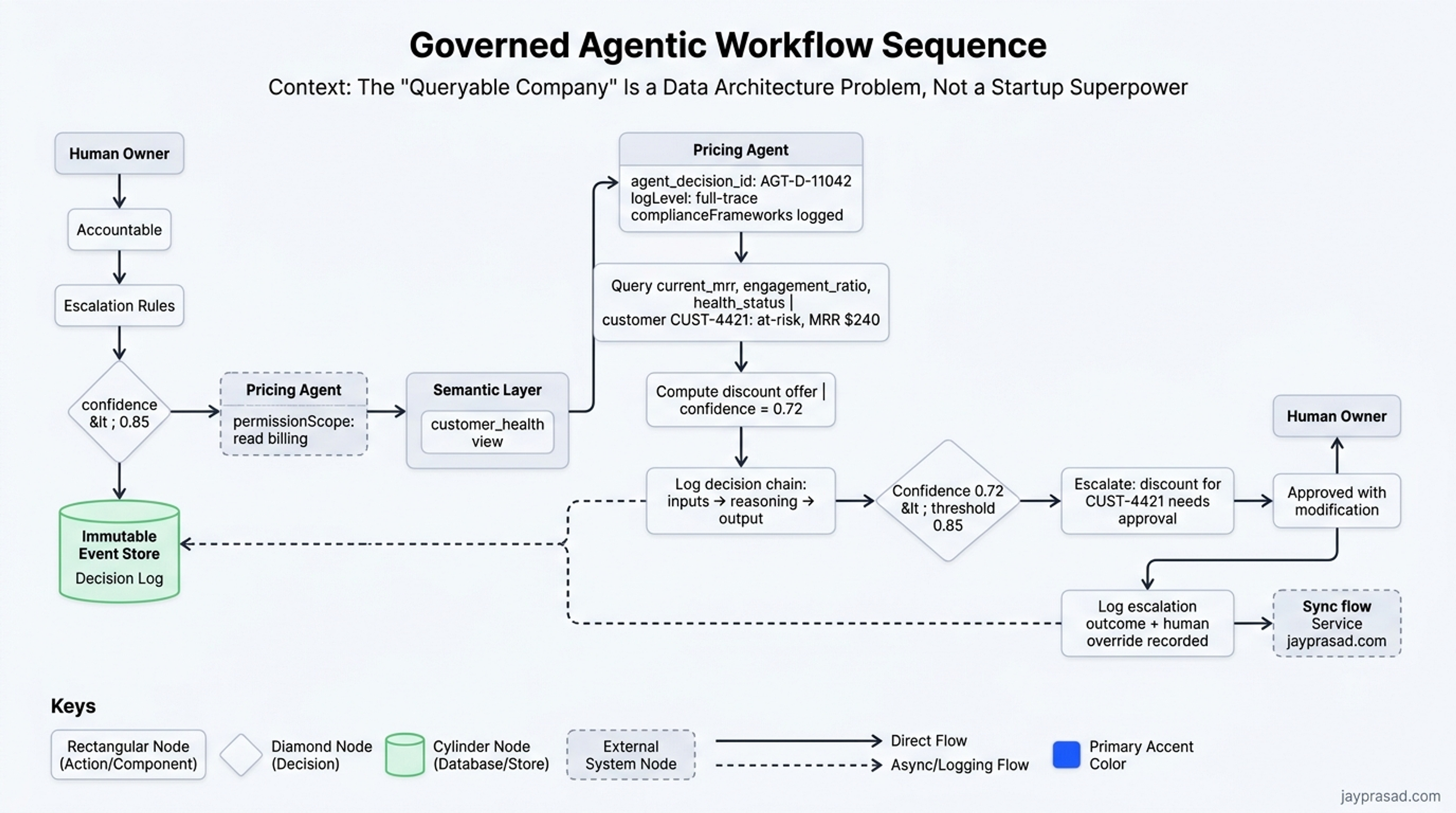
The companies that will succeed aren't the ones that eliminate middle management. They're the ones that replace ad-hoc human coordination with well-governed agentic workflows where accountability and auditability are first-class design requirements.
In practice, this means:
- Every agent has a defined permission scope (what data it can read, what actions it can take)
- Every agent decision has a traceable decision chain (inputs → reasoning → output → outcome)
- Escalation paths are explicit. The agent knows when to hand off to a human.
- Accountability is assigned to a human owner for every agentic workflow
// Agent workflow with explicit governance
interface AgentWorkflow {
  id: string;
  owner: string;           // Human accountable
  permissionScope: {
    read: DataContract[];
    write: DataContract[];
    actions: AllowedAction[];
  };
  escalationRules: {
    condition: string;      // e.g., "confidence < 0.85"
    escalateTo: string;     // Human or senior agent
    maxLatency: Duration;
  }[];
  auditConfig: {
    logLevel: 'decision' | 'full-trace';
    retentionDays: number;
    complianceFrameworks: string[];
  };
}
This is the architectural pattern that makes AI-native organizations viable at scale. It's not flat. It's not hierarchy-free. It's differently structured, with governance embedded in the system rather than emergent from org chart proximity.
---
The 1,000x Engineer Hits a 1x Organization
The "1,000x engineer" framing is exciting. It's also incomplete. Yes, individual throughput can skyrocket when an engineer delegates boilerplate coding, testing, and documentation to AI agents. But throughput without absorption capacity creates new bottlenecks.
I've seen this pattern before. When one person can produce code at 1,000x the previous rate, the constraints migrate:
- Code review, Who validates AI-generated output at that volume?
- CI/CD infrastructure, Can deployment pipelines handle the throughput?
- Customer feedback loops, Can product teams process signal from features shipping 1,000x faster?
- Strategic alignment, Is all this output pointed in the right direction?
The organizational architecture must be designed to absorb high-throughput output. Otherwise you get what I'd call output flooding, a system producing more artifacts than it can validate, deploy, or learn from.
The Absorption Capacity Checklist
Before celebrating 1,000x individual leverage, evaluate whether your organization can actually handle it:
- [ ] Automated code review pipelines that catch semantic errors, not just lint violations
- [ ] Deployment infrastructure with feature flags and progressive rollout
- [ ] Monitoring that detects behavioral regressions within minutes, not days
- [ ] Product feedback loops that can process signal at the rate features ship
- [ ] Strategic review cadence that keeps high-throughput output aligned with business goals
- [ ] Incident response playbooks for AI-generated code failures in production
The biggest gap in the AI-native company discourse isn't technical. It's organizational. Companies have models, tools, and pilots. What they often lack are the skills to frame decisions, redesign workflows, and collaborate effectively with AI at the system level.
---
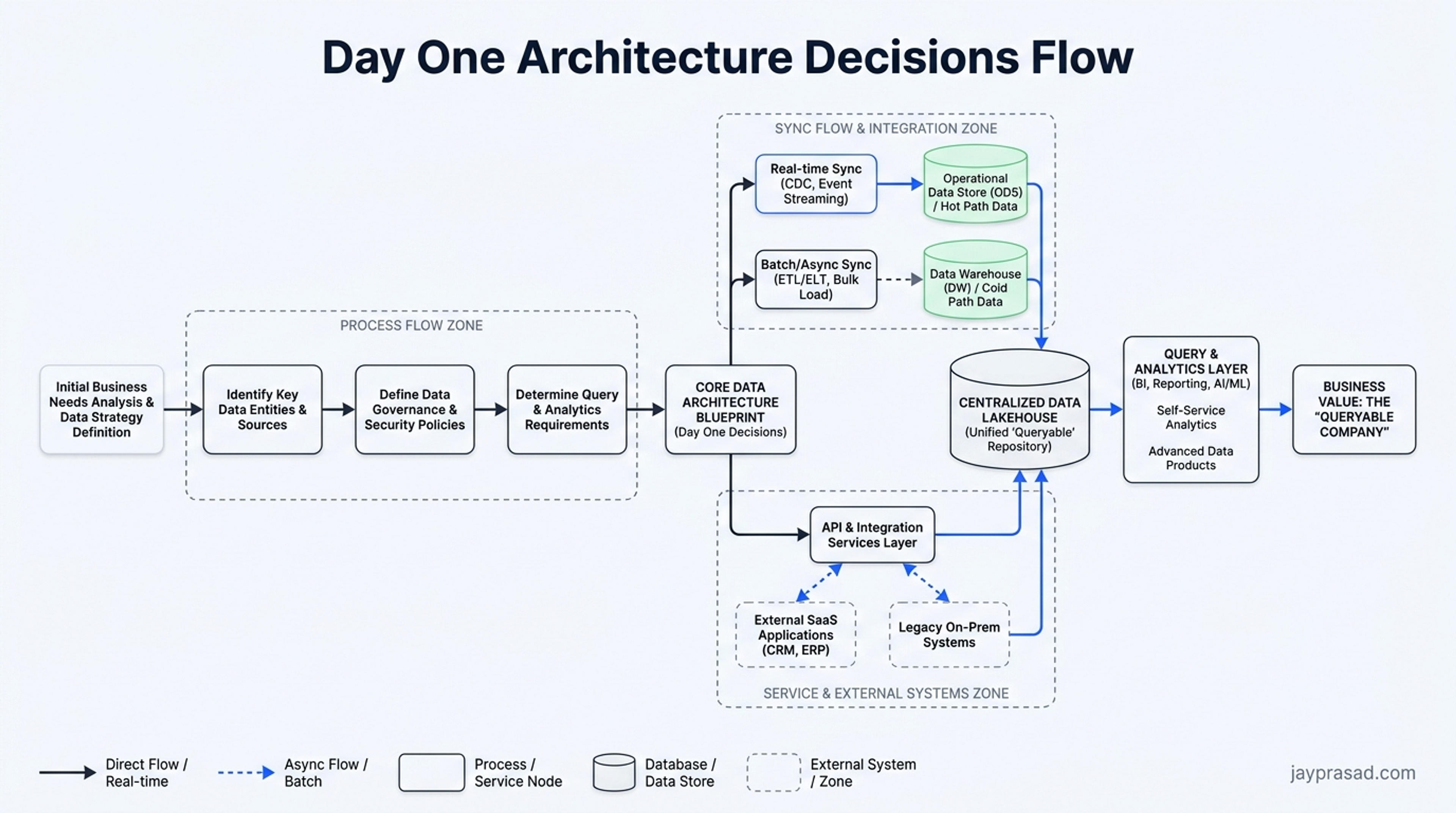
The Day-One Architecture Decisions That Actually Matter
Early-stage founders do have a massive edge in building this way from day one. But that edge only materializes if they make specific architectural choices early. Choices that most skip because they feel like premature optimization.
They're not.
The Non-Negotiable Foundations
- Event-driven from the start. Every state change is an event. Every event is immutable. This gives you auditability, replayability, and a complete history for agents to reason over.
- Schema-first development. Define your data contracts before you write application code. If an agent can't programmatically understand the shape and semantics of your data, your company isn't queryable. Period.
- Agent permission model on day one. Don't bolt on access control later. Define what each agent can read, write, and do from the first deployment.
- Structured decision logging. Every decision, human or agent, gets logged with inputs, reasoning, and outcome. This is your organizational memory.
- Semantic layer before dashboards. Build the abstraction that gives business meaning to raw data before you build any reporting. Your agents and your humans should query the same layer.
-- Semantic layer example: unified customer view
-- Both humans and agents query this, not raw tables
CREATE VIEW semantic.customer_health AS
SELECT
  c.customer_id,
  c.segment,
  COALESCE(s.mrr, 0) AS current_mrr,
  d.tickets_last_30d,
  d.avg_resolution_hours,
  u.dau_over_mau AS engagement_ratio,
  CASE
    WHEN u.dau_over_mau < 0.1
     AND d.tickets_last_30d > 3
    THEN 'at-risk'
    ELSE 'healthy'
  END AS health_status
FROM core.customers c
LEFT JOIN billing.subscriptions s USING (customer_id)
LEFT JOIN support.ticket_metrics d USING (customer_id)
LEFT JOIN product.usage_metrics u USING (customer_id);
The critical gap: this view is trivial to write on day one. It's nearly impossible to retrofit when you have 47 microservices, three data warehouses, and a Salesforce instance that nobody fully understands.
---
The Destination Is Right. The Map Runs Through Enterprise Architecture.
But the map to get there runs through enterprise data architecture patterns: event sourcing, semantic layers, data contracts, agent-accessible knowledge graphs, governed agentic workflows. The startup world chronically underestimates these. The enterprise world has been wrestling with them for years.
The companies that win this transition won't be the ones with the flattest org charts or the most aggressive model adoption. They'll be the ones that treat internal data as a first-class product, embed governance into their agent architectures from day one, and build organizations that can absorb AI-augmented throughput without creating new bottlenecks in review, deployment, and strategic alignment.
The queryable company isn't a feature you ship. It's a data architecture discipline you practice daily. And the moment you cut corners on schema design or skip the governance model, your AI agents start hallucinating not just text, but business decisions.
Discussion
Responses, reactions, and open questions.
The article stays static. The conversation sits underneath it. Sign in with your email, react to the argument, and join the discussion.
Join the discussion
Use your email to get a one-time sign-in code. First comments may wait in moderation before they appear publicly.