Semantic Layers Beat Model Upgrades for AI Agents
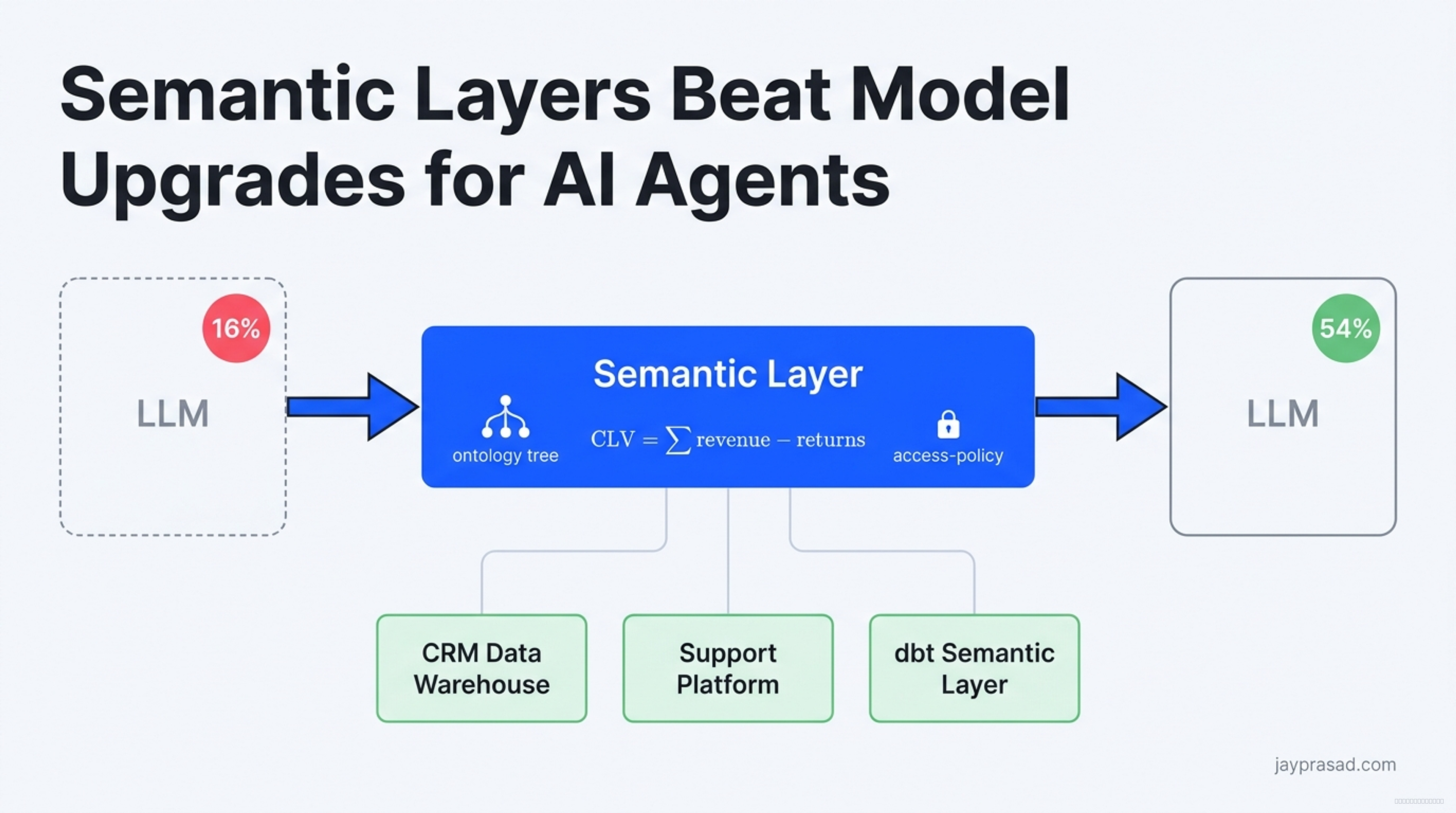
The enterprise AI bottleneck isn't model quality - it's machine-interpretable meaning, and semantic layers are the infrastructure that closes the gap.
Listen to this article
Core argument
The short version of the piece before you go deeper.
The enterprise AI bottleneck isn't model quality - it's machine-interpretable meaning, and semantic layers are the infrastructure that closes the gap.
# Semantic Layer for AI Agents: The Infrastructure Nobody's Building
The model arms race is a distraction. While companies pour budgets into bigger LLMs and GPU clusters, a 2024 study from data.world found something striking. Adding a semantic layer for AI agents boosted LLM accuracy on company data from 16% to 54%, and up to 90% for certain query types.
No model upgrade delivers that kind of improvement. The bottleneck isn't intelligence. It's meaning.
Close to 25% of companies deployed AI agents in 2025. That number is projected to hit 50% by 2027. But without semantic infrastructure, these agents will fail at scale.
---
The Problem: Agents Are Powerful but Blind
An AI agent that autonomously runs business processes needs more than raw data access. It needs to understand what the data means.
Here's a simple example. Two systems define "customer value" differently. The CRM calculates it as lifetime revenue. The support platform calculates it as a satisfaction-weighted engagement score.
A human analyst knows which definition to use in context. An AI agent doesn't. It picks whichever source it hits first and makes a decision based on the wrong number.
That's the real risk. When an agent misinterprets a metric, it doesn't produce a bad chart. It makes a bad decision. And in autonomous systems, that decision executes before anyone reviews it.
This isn't hypothetical. It's the default behavior of every LLM-powered agent operating against company data without a semantic layer.
What a Semantic Layer Actually Is
The term gets thrown around loosely. Let me be precise.
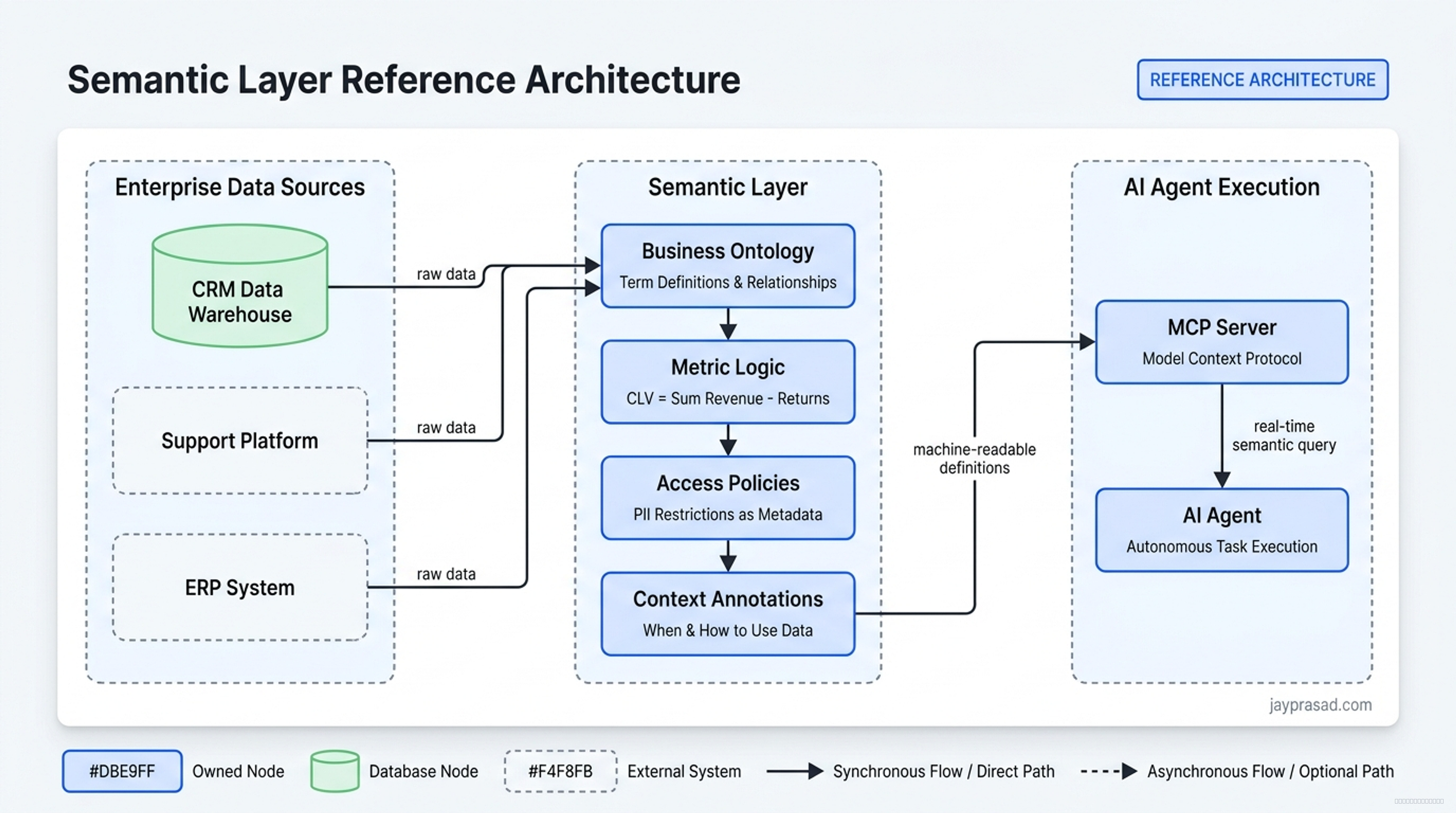
A semantic layer is a machine-readable translation guide that maps raw data to business meaning. It sits between your data stores and your AI systems. Think of it as a dictionary that tells AI agents not just where data lives, but what it actually means and how to use it correctly.
A working semantic layer includes several components. First, business term definitions with formal relationships, sometimes called ontologies (structured maps of how concepts relate to each other). Second, metric logic, meaning how KPIs are calculated, with source lineage so you can trace where numbers come from.
It also needs access policies embedded as metadata, not bolted on after the fact. And it requires context annotations that tell agents when and how to use specific data elements.
Without this layer, agents rely on column names, table schemas, and whatever context fits in a prompt. That's why accuracy sits at 16% without semantics.
---
Why the Model Arms Race Is the Wrong Investment
Most companies allocate roughly 80% of their AI budget to models and compute. The remaining 20% goes to data readiness. The research suggests that ratio should be inverted.
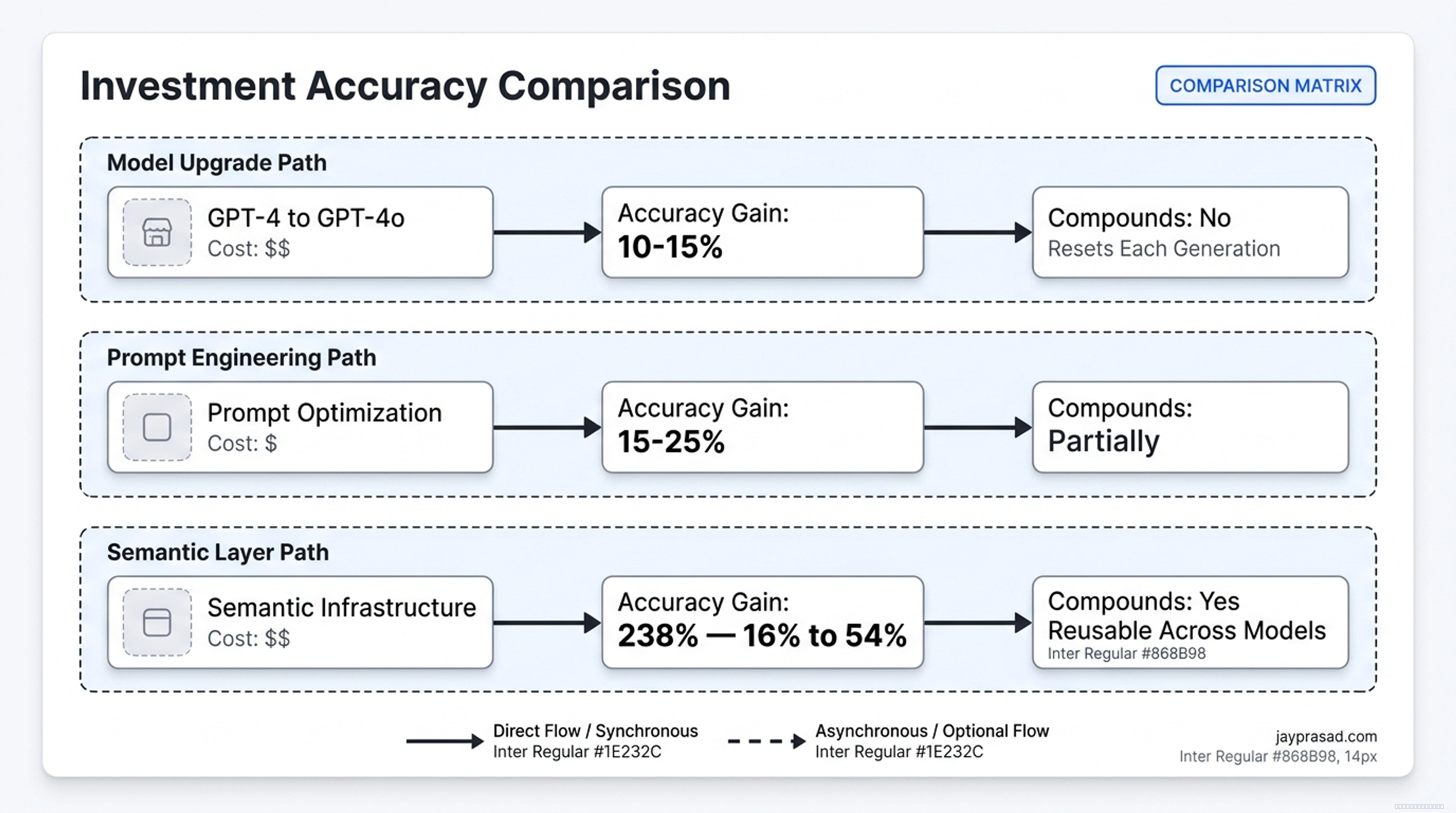
Here's the math. Upgrading from GPT-4 to GPT-4o might improve general reasoning by 10-15%. Adding a semantic layer improved domain-specific accuracy by 238% (16% to 54%).
| Investment | Typical Cost | Accuracy Gain | Compounds Over Time? |
|---|---|---|---|
| Model upgrade | $$ | 10-15% | No (resets each generation) |
| Prompt engineering | $ | 15-25% | Partially |
| Semantic layer | $$ | 200%+ | Yes (reusable across models) |
The semantic layer is the only investment that compounds. It works across model providers, agent frameworks, and use cases. When you swap models next year, the semantic layer still applies.
I'll say it plainly: the AI moat isn't your model. It's your metadata. The organizations that build machine-readable semantic infrastructure now will have a durable advantage that no model upgrade can replicate.
---
Three Architectural Approaches, Different Tradeoffs
Company data is messy. Nobody achieves a single unified semantic layer overnight. There are three patterns in practice today, each with different tradeoffs.
| Pattern | Examples | Strengths | Weaknesses |
|---|---|---|---|
| Unified semantic layer | Company-wide knowledge graph, centralized ontology | Consistency, cross-domain queries | High upfront cost, slow to build |
| Cloud-provider layer | Databricks Unity Catalog, Snowflake Cortex | Native integration, lower friction | Vendor lock-in, cloud-scoped |
| Tool-specific layer | dbt semantic layer, Looker modeling | Fast to deploy, team-owned | Siloed, limited interoperability |
The Pragmatic Path: Federated, Not Monolithic
The right answer for most organizations is a federated approach. Start with domain-specific semantic layers. Connect them through shared ontologies and protocols.
This mirrors how microservices architecture evolved. You don't build one giant service. You build bounded contexts with well-defined contracts between them.
For a semantic layer, that looks like this in practice:
- Name the domain (e.g., "Customer Analytics") and assign an owner team.
- Define each business term formally. For example: "Customer Lifetime Value = sum of all revenue attributed to a customer over the full relationship, minus returns and credits."
- Document the calculation logic so an agent knows exactly which tables and fields to query.
- Tag the source system (e.g., CRM data warehouse) and how often it refreshes (e.g., daily).
- Attach access policies directly to the definition (e.g., "PII-restricted, requires elevated permissions").
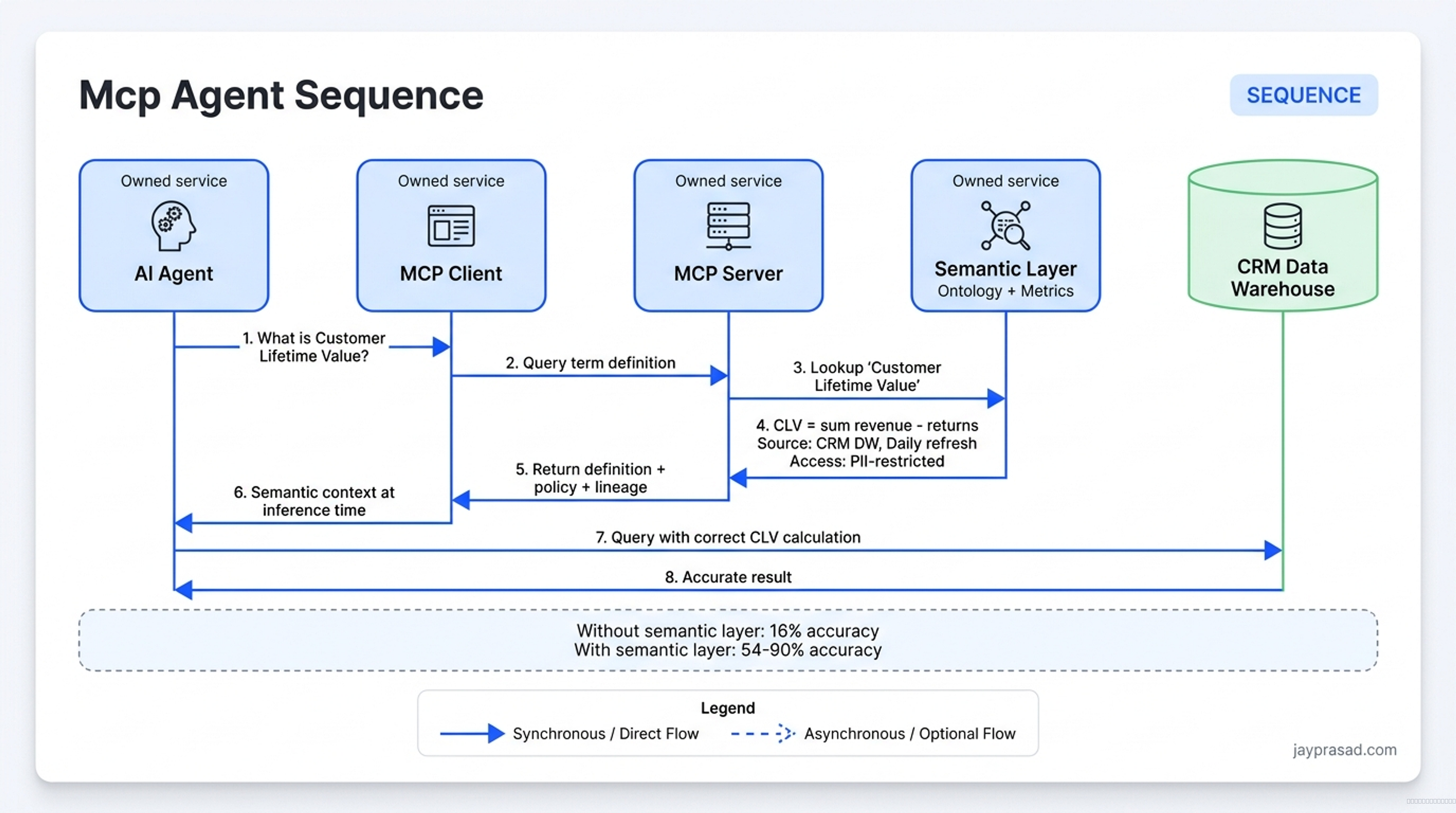
This isn't documentation for humans. It's a machine-readable definition that an AI agent can consume at inference time, which is the moment it's actually answering a question, to understand what "customer lifetime value" means, how it's calculated, and who can access it.
---
MCP: The Protocol That Makes Semantics Operational
The most forward-looking piece of this architecture is MCP, the Model Context Protocol. MCP turns metadata catalogs from passive documentation into active, queryable services that agents can talk to in real time.
Here's the core idea. An MCP server defines how agents interact with a specific API. An MCP client creates a one-to-one connection from an agent to that server. The agent can query the semantic layer in real time during task execution. Think of it like a live reference librarian that an agent can ask, "What does this term mean and am I allowed to use it?" before making a decision.
How MCP Compares to Alternatives
There are several ways to connect agents to semantic metadata. MCP is one option.
| Approach | Semantic Awareness | Standardization | Maturity |
|---|---|---|---|
| MCP | High, purpose-built | Open protocol | Early |
| Function calling | Medium, manual mapping | Vendor-specific | Mature |
| Tool-use APIs | Low, no semantic context | Varies | Mature |
| RAG over docs | Low, unstructured | N/A | Mature |
RAG, or retrieval augmented generation, is the pattern where an AI pulls in relevant documents before answering a question. It works well for many things, but using RAG over documentation about structured data is a rough fit. You're asking the model to extract meaning from unstructured text about structured data. That's a lot of translation for the AI to do on its own.
MCP's advantage is that it's designed specifically for this use case. Function calling works too, but you have to manually encode semantic context into each function definition. That doesn't scale.
MCP's Limitations
MCP is early. The protocol lacks mature authentication and authorization patterns. It doesn't handle semantic versioning well yet. And there's no standard for conflict resolution when multiple MCP servers define the same term differently.
These are solvable problems. But they're not solved yet.
---
Who Owns the Semantic Layer?
The natural candidate is the Chief Data Officer (CDO). That's necessary but insufficient.
The CDO role as currently defined focuses on data availability, governance, and compliance. Owning the semantic layer for AI agents requires something broader. It spans data engineering, application architecture, and AI platform teams.
The Ownership Gap
Here's the real organizational challenge. No single team has the full picture.
- Data teams understand schemas and lineage but not agent behavior
- AI/ML teams understand model needs but not company-wide data semantics
- Business teams understand meaning but can't encode it formally
- Platform teams understand infrastructure but not domain context
A semantic layer that works for AI agents needs all four perspectives. The CDO can coordinate, but this is fundamentally a cross-functional architecture problem.
One thing that often gets overlooked: automation can bootstrap ontologies, but business meaning drifts. Product definitions change. Metric calculations evolve. Human curation isn't optional. It's ongoing maintenance, like code review for your data's meaning.
---
Readiness Checklist
Before investing in semantic infrastructure, assess where you stand.
- [ ] You have a catalog of business terms with formal definitions (not just a wiki page)
- [ ] Metric calculations are documented with source lineage
- [ ] At least one domain has a machine-readable ontology
- [ ] Data access policies are encoded as metadata, not just permission rules
- [ ] You can answer "What does 'revenue' mean?" and get one answer
- [ ] Your AI agents currently access raw data without semantic context
- [ ] You have a cross-functional team (data + AI + business) that could own this
If fewer than three boxes are checked, you have significant metadata debt, the invisible, compounding liability that makes every AI deployment harder and less accurate. It's like technical debt, but for the meaning of your data instead of the quality of your code.
---
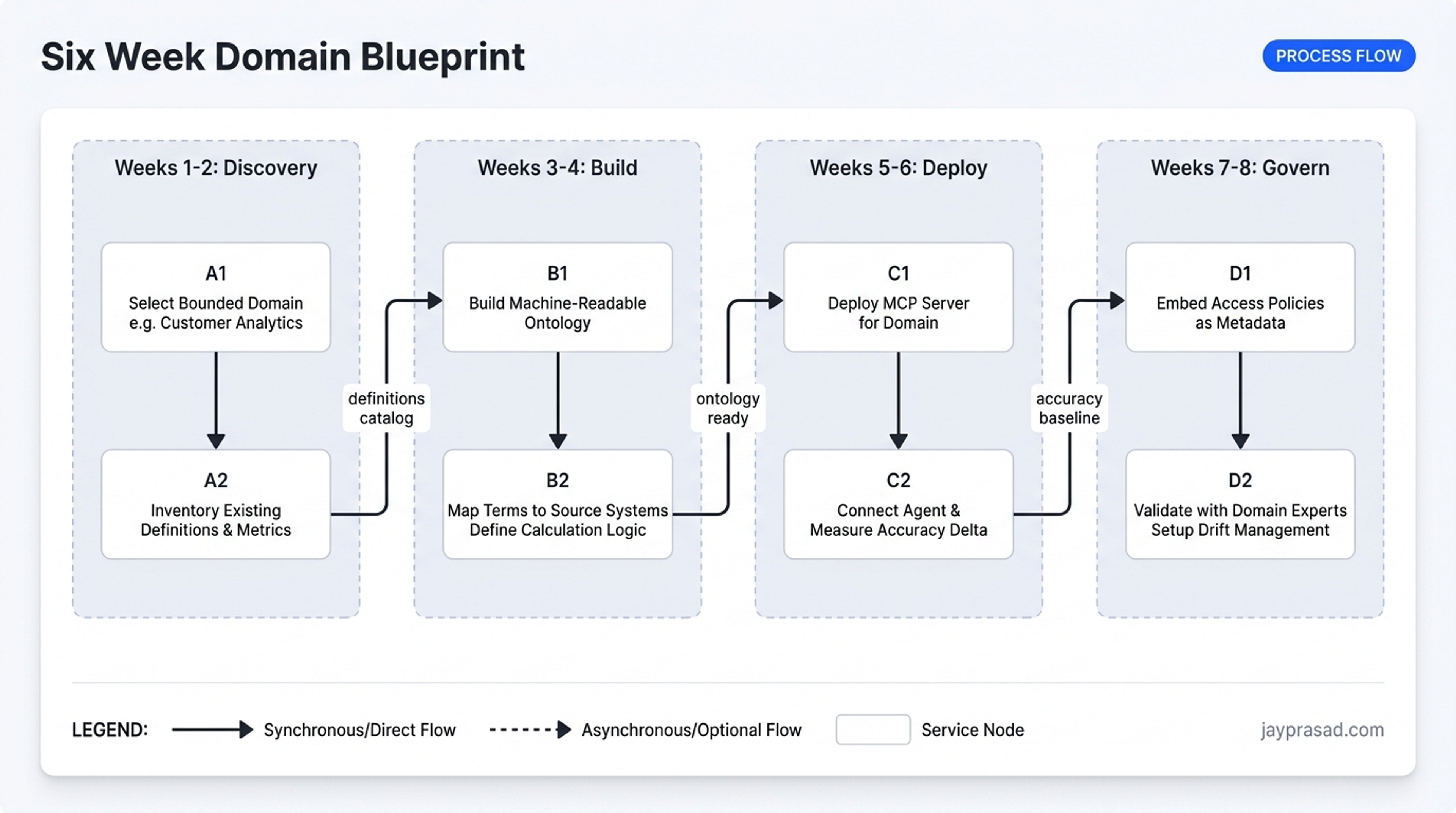
The 6-8 Week Blueprint: Start With One Domain
A realistic timeline for a single domain is 6-8 weeks. That's aggressive but doable.
- Weeks 1-2: Select a bounded domain (e.g., customer analytics). Inventory existing definitions and metrics.
- Weeks 3-4: Build a machine-readable ontology. Map terms to source systems. Define calculation logic.
- Weeks 5-6: Deploy an MCP server for the domain. Connect one agent to it. Measure the accuracy difference.
- Weeks 7-8: Add governance policies as metadata. Validate with domain experts. Document a drift-management process.
The key metric is the accuracy delta between agent performance with and without the semantic layer. If you're not measuring this, you're flying blind.
---
Governance as an Enabling Layer
The most important shift here isn't technical. It's philosophical.
Governance needs to evolve from a compliance bolt-on to a functional layer of AI infrastructure. In agent-driven environments, policies can't be imposed after the fact. They need to be woven into the logic that tells agents how to behave.
Access controls, data quality rules, and usage policies become part of the semantic layer itself. They're not separate systems. They're metadata that agents consume alongside business definitions.
The organizations that treat semantic infrastructure as the operating system for AI agents, not as a data governance side project, will be the ones whose agents actually work in production. The model is a commodity. The meaning is the moat.
Discussion
Responses, reactions, and open questions.
The article stays static. The conversation sits underneath it. Sign in with your email, react to the argument, and join the discussion.
Join the discussion
Use your email to get a one-time sign-in code. First comments may wait in moderation before they appear publicly.