Why Salesforce's Agent Platform Is Actually Genius Lock-In
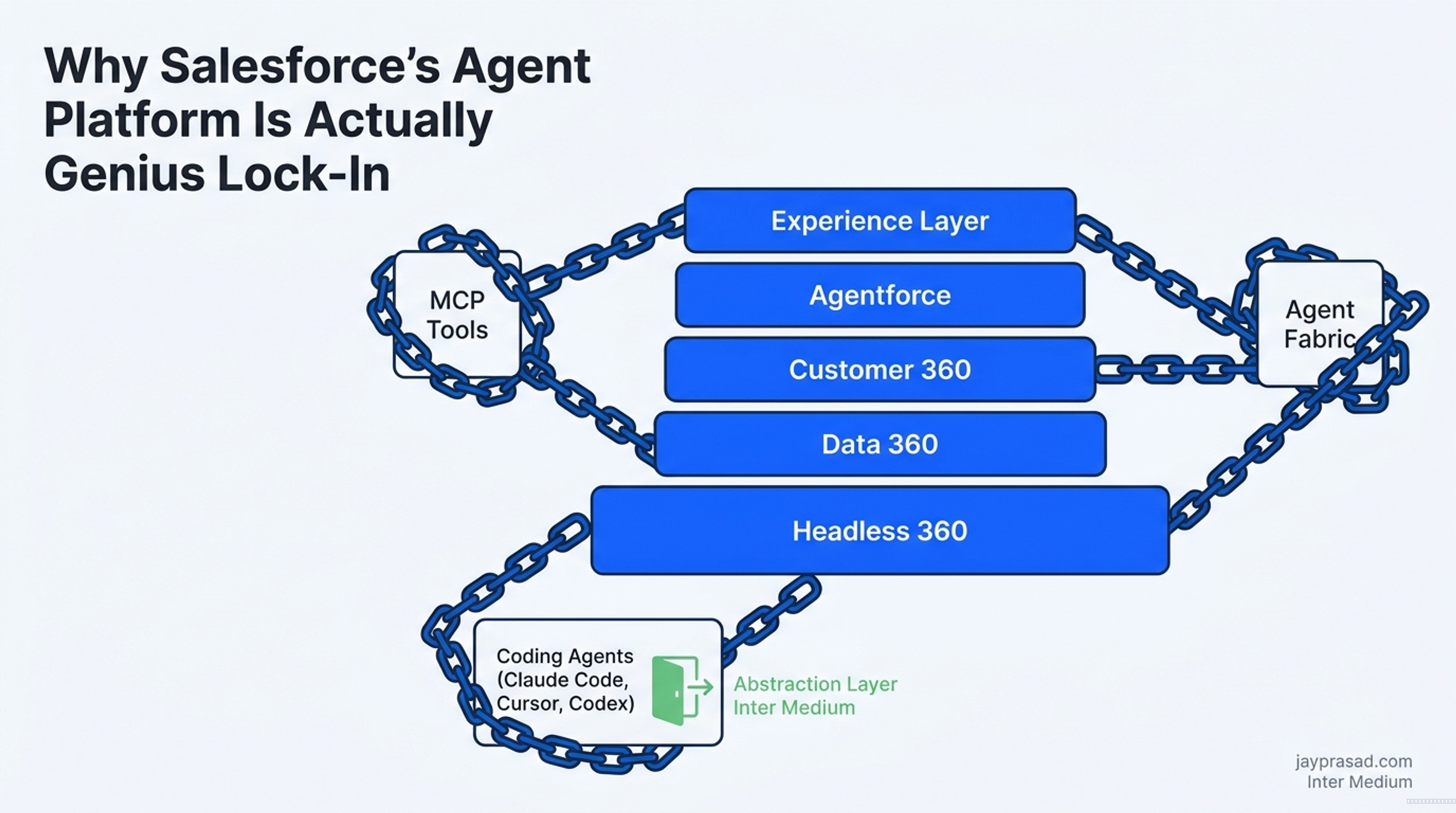
Headless 360 shifts lock-in from the UI to the infrastructure — enterprises adopting it without abstraction layers trade visible constraints for invisible ones.
Listen to this article
Core argument
The short version of the piece before you go deeper.
Headless 360 shifts lock-in from the UI to the infrastructure — enterprises adopting it without abstraction layers trade visible constraints for invisible ones.
# Salesforce Headless 360 Is the Most Sophisticated Lock-In Play in Enterprise Software History
Salesforce just told its customers to stop logging in. That's not a UX redesign. It's a platform-level declaration that the 25-year-old UI-centric SaaS model is dead, and that the future of enterprise software is being consumed by agents, not navigated by humans.
Salesforce Headless 360, announced in June 2025, exposes 60+ MCP tools, 30+ coding skills, a new Experience Layer, and an orchestration control plane called Agent Fabric. The marketing narrative frames this as liberation: build any way you want, deploy anywhere, let agents do the work.
The architecture is genuinely coherent. The strategy is directionally correct. And it's also the most carefully constructed lock-in mechanism enterprise software has ever produced.
Here's why, and what architects should do about it.
---
The Four-Layer Stack: What Salesforce Actually Built
Salesforce is reorganizing its entire platform into a four-layer architecture designed for programmatic consumption:
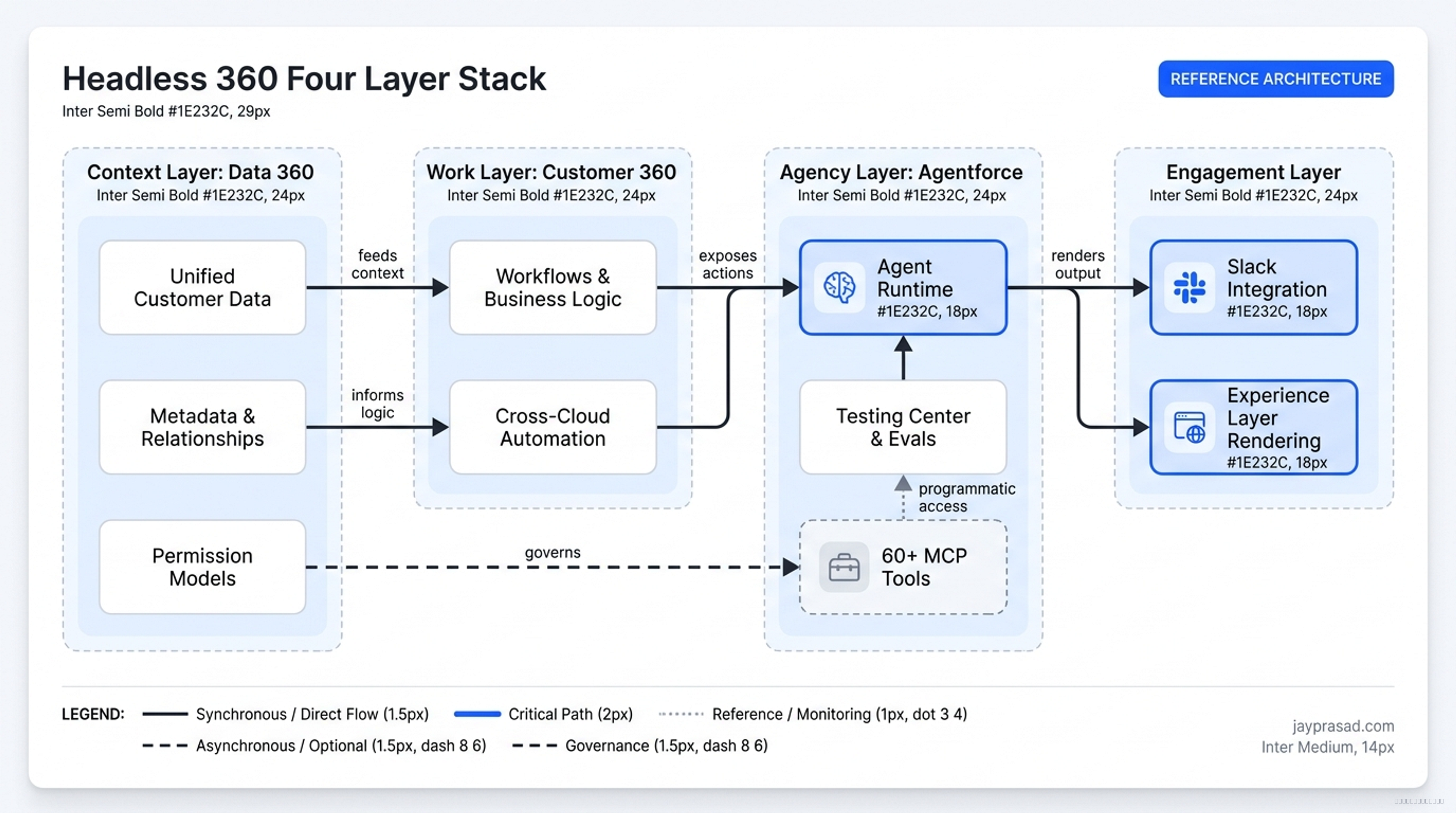
| Layer | Name | Function | What It Replaces |
|---|---|---|---|
| Context | Data 360 | Unified customer data, metadata, relationships | Fragmented data objects across clouds |
| Work | Customer 360 | Workflows, business logic, permissions | Cloud-specific UI-driven automation |
| Agency | Agentforce | Agent runtime, testing, evaluation | Manual process execution |
| Engagement | Slack + Experience Layer | Rendering agent outputs across surfaces | Salesforce UI as the primary interface |
Architecturally sound. The separation of context from workflow from agency from rendering is exactly how you'd design a platform for agentic consumption if you were starting from scratch.
Here's the insight Salesforce is banking on: a coding agent connected to a raw database doesn't know that a customer has an open escalation, a renewal due in 30 days, a breached SLA, and a relationship owner with a personal connection to their CFO. That accumulated business context is the moat.
The contrarian read: Salesforce is framing accumulated data as a feature. But for most orgs, that accumulated data is a liability. Decades of dirty records, inconsistent picklists, orphaned accounts, and business logic that nobody fully understands. Agents don't work around bad data the way humans do. They amplify it.
---
The MCP Bet: Bold, Premature, and Strategically Brilliant
Salesforce is going all-in on Model Context Protocol (MCP) as the interoperability standard for agent-to-platform communication. The 60+ MCP tools give coding agents like Claude Code, Cursor, Codex, and Windsurf live access to your entire Salesforce org: data, workflows, business logic, permissions.
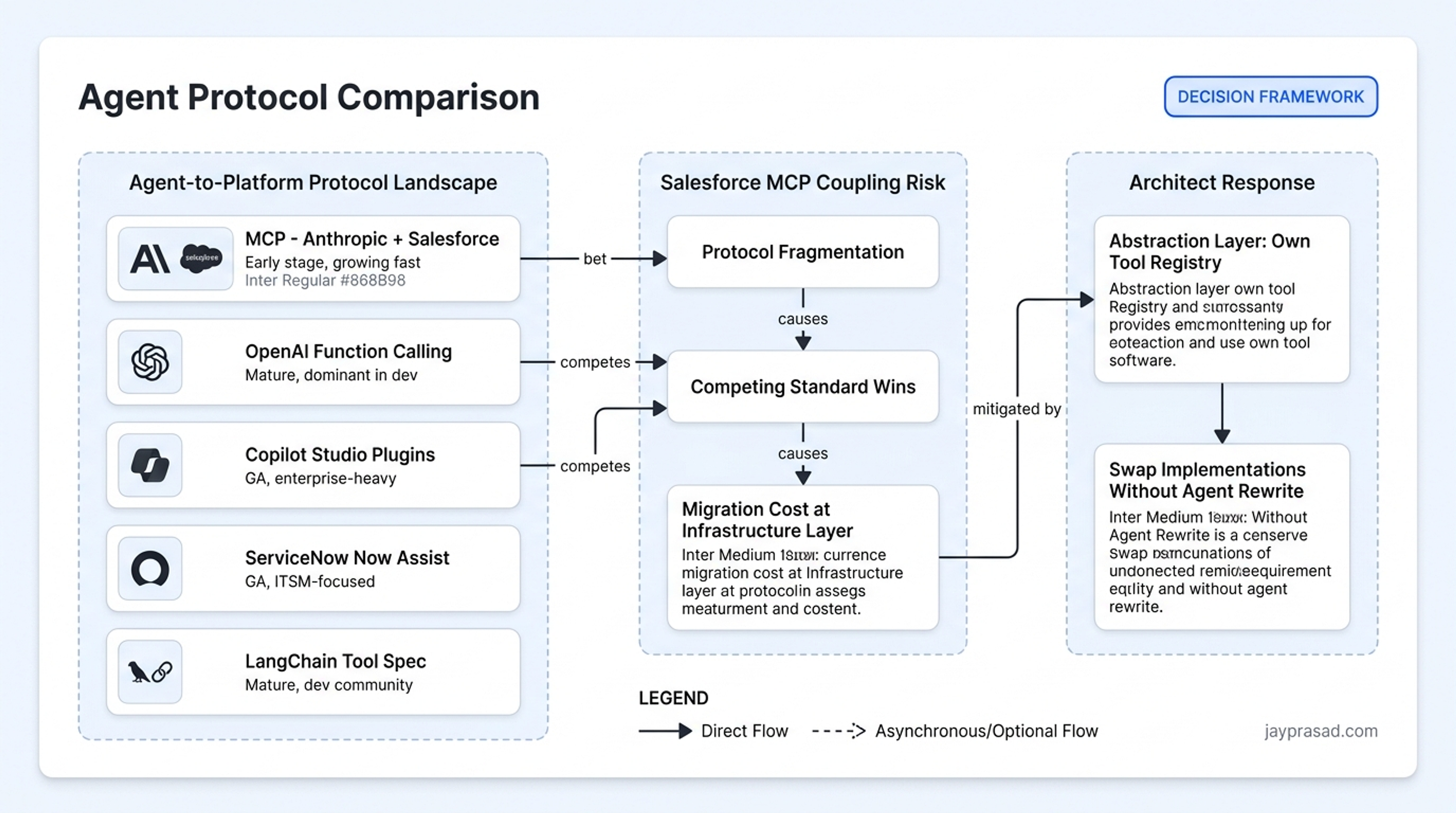
It's a calculated bet. MCP, originally developed by Anthropic, is still early-stage. It's gaining adoption, but it's not a ratified standard. Salesforce is essentially choosing a protocol and daring the ecosystem to follow.
Why It Might Pay Off
MCP solves a real problem: the N×M integration explosion between agents and enterprise tools. Instead of building custom connectors for every agent-tool pair, MCP provides a standardized interface. Salesforce shipping 60+ tools on day one creates gravity. If the largest enterprise SaaS platform speaks MCP natively, agent framework developers have strong incentive to support it.
Why Architects Should Be Nervous
MCP isn't the only game in town. Microsoft's Copilot Studio uses its own orchestration patterns. ServiceNow has its own agent framework. OpenAI's function calling and tool-use patterns predate MCP and have massive adoption.
| Protocol/Approach | Backing | Maturity | Adoption |
|---|---|---|---|
| MCP (Anthropic) | Anthropic + Salesforce | Early | Growing fast |
| OpenAI Function Calling | OpenAI | Mature | Dominant in dev |
| Copilot Studio Plugins | Microsoft | GA | Enterprise-heavy |
| ServiceNow Now Assist | ServiceNow | GA | ITSM-focused |
| LangChain Tool Spec | Open source | Mature | Dev community |
If MCP fragments or loses to a competing standard, enterprises that built their agent architecture around Salesforce's MCP tools face a migration problem. Not because MCP is bad, but because protocol bets at the infrastructure layer have long half-lives.
Key warning: Treat MCP tooling the way you'd treat any infrastructure dependency. Build an abstraction layer between your agent orchestration logic and the Salesforce MCP surface. If you let agents call Salesforce MCP tools directly with no intermediary, you're coupling your agent architecture to both a platform and a protocol simultaneously. That's a footgun.
---
Agent Fabric: The Control Plane Play
Agent Fabric is where the lock-in story gets serious. Salesforce positions it as a "multi-vendor control plane" with "deterministic orchestration and centralized agent, tool, and LLM governance" across your entire AI stack.
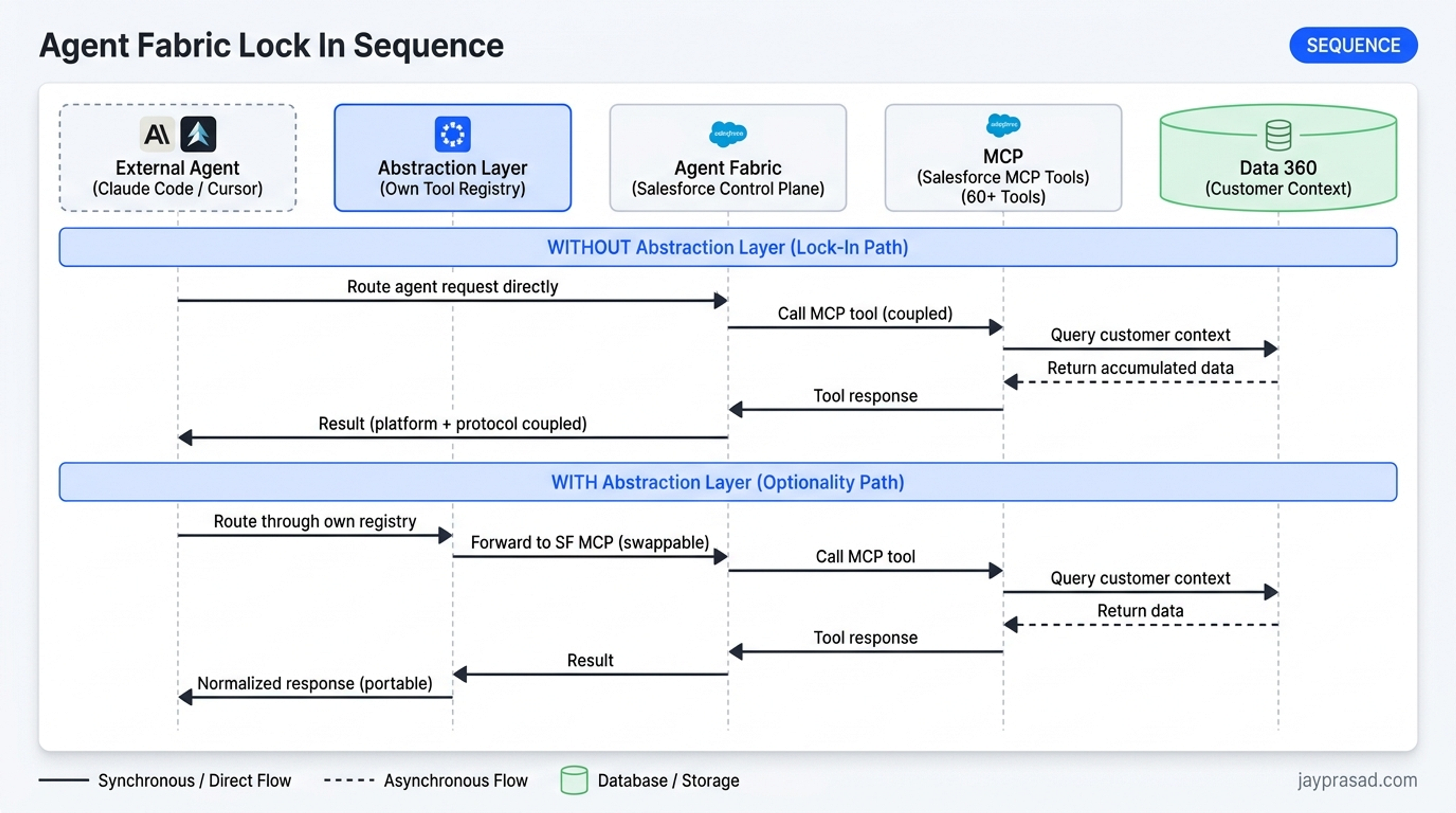
Translation: Salesforce wants to be the router, the policy engine, and the audit log for every agent in your enterprise. Including agents that don't run on Salesforce.
Classic platform play. It's the same strategy that made Kubernetes the center of gravity for container orchestration, or that made Snowflake the control plane for data sharing. Whoever owns the orchestration layer owns the switching costs.
The First-Class Citizen Problem
Salesforce claims Agent Fabric will treat non-Salesforce agents as first-class citizens. I've seen this movie before. Every platform vendor that has built a "multi-vendor orchestration layer" has eventually optimized for its own ecosystem:
- Microsoft built "open" Azure integrations that work best with Microsoft 365
- Google built Vertex AI as "model-agnostic" but optimized for Gemini
- AWS built Bedrock as "multi-model" but steered toward Titan and Nova
There's no reason to believe Salesforce will be different. Agent Fabric will work best with Agentforce agents consuming Salesforce data through Salesforce MCP tools. Non-Salesforce agents will work, but with more friction, fewer governance features, and slower access to new capabilities.
Nobody breaks this pattern. Nobody.
---
The Data Quality Time Bomb
The announcement glosses over this entirely. It's the dimension that matters most.
Salesforce's moat argument, "that context took years to accumulate, it lives in Salesforce," only holds if the data is trustworthy. For most enterprises, it isn't.
What Agents Do With Bad Data
A human sales rep looking at a Salesforce account with a wrong phone number, a duplicate contact, and a stale opportunity amount can work around it. They know the real number. They know which contact is current. They have context from last week's call.
An agent consuming the same data via MCP has none of that. It takes the data at face value. It calls the wrong number. It emails the duplicate. It quotes the stale amount. At machine speed. Across hundreds of accounts simultaneously.
Salesforce explicitly acknowledges that agents are "probabilistic, not deterministic" and that "there is no bug to fix but behavior to observe, evaluate, and tune." What they don't say: probabilistic systems operating on unreliable data don't just make occasional mistakes. They make confidently wrong decisions at scale.
What This Means Architecturally
If you're planning to adopt Headless 360, your data quality investment needs to precede your agent deployment. Not follow it. Specifically:
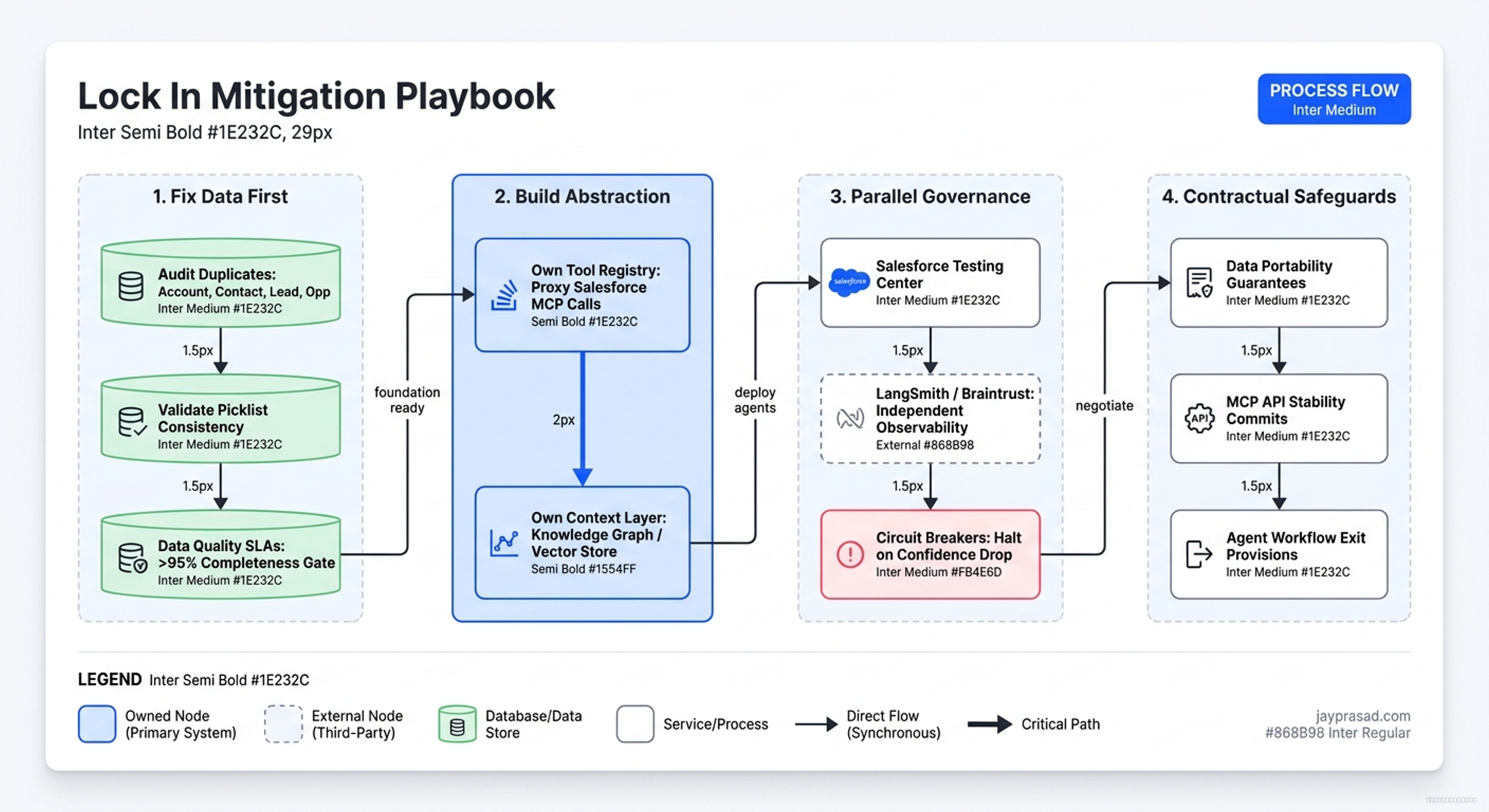
- [ ] Audit duplicate rates across Account, Contact, Lead, and Opportunity objects
- [ ] Validate that picklist values are consistent and semantically meaningful (agents parse these)
- [ ] Ensure real-time data pipelines feed current state. Stale data is worse than no data for agents.
- [ ] Build semantic models that map Salesforce field names to business meaning (agents need this context)
- [ ] Establish data quality SLAs with measurable thresholds before granting agent access
- [ ] Implement circuit breakers that halt agent actions when data confidence drops below threshold
Without this foundation, Headless 360 doesn't amplify your competitive advantage. It amplifies your data debt.
---
Testing and Governance: Necessary but Unproven
Salesforce announced a Testing Center with custom scoring evals and A/B testing for agents. Right idea. The question is whether it's mature enough for production enterprise use cases.
The Eval Landscape
Agent evaluation is an emerging discipline. Several frameworks are competing:
| Framework | Type | Strengths | Limitations |
|---|---|---|---|
| Salesforce Testing Center | Proprietary | Integrated with Agentforce, org-aware | Untested at scale, closed ecosystem |
| DeepEval | Open source | Flexible metrics, CI/CD integration | Requires custom setup |
| Ragas | Open source | RAG-focused evaluation | Narrow scope |
| Braintrust | Commercial | Production logging + evals | Not Salesforce-native |
| LangSmith | Commercial | Tracing + evaluation | LangChain-centric |
Salesforce's advantage is that its Testing Center understands the org's permission model, business logic, and data relationships. That's genuinely valuable. You can't replicate it easily with a generic eval framework.
The risk: enterprise edge cases are weird. A pharmaceutical company's Salesforce org has compliance rules that interact with territory assignments that interact with formulary data that interact with HCP relationship tracking. Testing whether an agent handles the intersection of all four correctly requires evaluation depth that no vendor has demonstrated yet. Not one.
What "Observe, Evaluate, and Tune" Actually Requires
# Example: Agent evaluation pipeline for Headless 360
agent_eval:
  pre_deployment:
    - golden_dataset_tests: 500+ cases
    - permission_boundary_tests: all profiles
    - data_quality_gate: >95% completeness

  canary_deployment:
    - traffic_split: 5% agent / 95% human
    - latency_budget_p99: 2000ms
    - error_rate_threshold: 0.1%
    - human_review_sample: 10%

  production:
    - continuous_eval_interval: 1h
    - drift_detection: embedding similarity
    - circuit_breaker: 3 consecutive failures
    - rollback_trigger: error_rate > 0.5%
If your org can't build and maintain something like this, you're not ready for agents making decisions against your Salesforce data. Full stop.
---
The Architect's Playbook: Adopt the Architecture, Mitigate the Lock-In
Headless 360 is directionally correct. The separation of data, logic, agency, and rendering is how enterprise platforms should evolve. But adopting it without a lock-in mitigation strategy is trading one set of constraints (UI-bound workflows) for a more insidious one (platform-bound agent intelligence).
That's the trap.
What to Do
- Build an abstraction layer between your agent orchestration and Salesforce's MCP surface. Don't let agents call Salesforce tools directly. Route through your own tool registry that can swap implementations.
- Own your context layer. Replicate critical Salesforce data into your own semantic layer (a knowledge graph, a vector store, a feature store). If your agents can only get context from Salesforce, you can never leave.
- Evaluate Agent Fabric skeptically. Use it if it genuinely solves multi-vendor orchestration. But run parallel governance through your own observability stack (LangSmith, Braintrust, or custom). Don't make Salesforce your single pane of glass for agent governance.
- Fix your data first. No amount of agentic architecture compensates for dirty CRM data. Budget 2-3x what you think data cleanup will cost. I'm serious.
- Negotiate contractually. If Salesforce is your agent control plane, your contract should include data portability guarantees, MCP tool API stability commitments, and exit provisions that account for agent workflow migration.
---
The Implication
Salesforce is right that the UI-centric SaaS era is ending. They're right that accumulated business context is a genuine moat. And they've built an architecturally coherent stack to capitalize on both insights.
But "headless" doesn't mean "free." It means the chains moved from the interface to the infrastructure. The enterprises that thrive in the agentic era won't be the ones that adopt Headless 360 fastest. They'll be the ones that adopt it with clear eyes about what they're buying into, abstraction layers that preserve optionality, and data foundations that agents can actually trust.
The platform that agents depend on for context becomes the platform you can never leave. Plan accordingly.
Discussion
Responses, reactions, and open questions.
The article stays static. The conversation sits underneath it. Sign in with your email, react to the argument, and join the discussion.
Join the discussion
Use your email to get a one-time sign-in code. First comments may wait in moderation before they appear publicly.