Google Just Shipped the Agent Mesh. Most People Missed It.
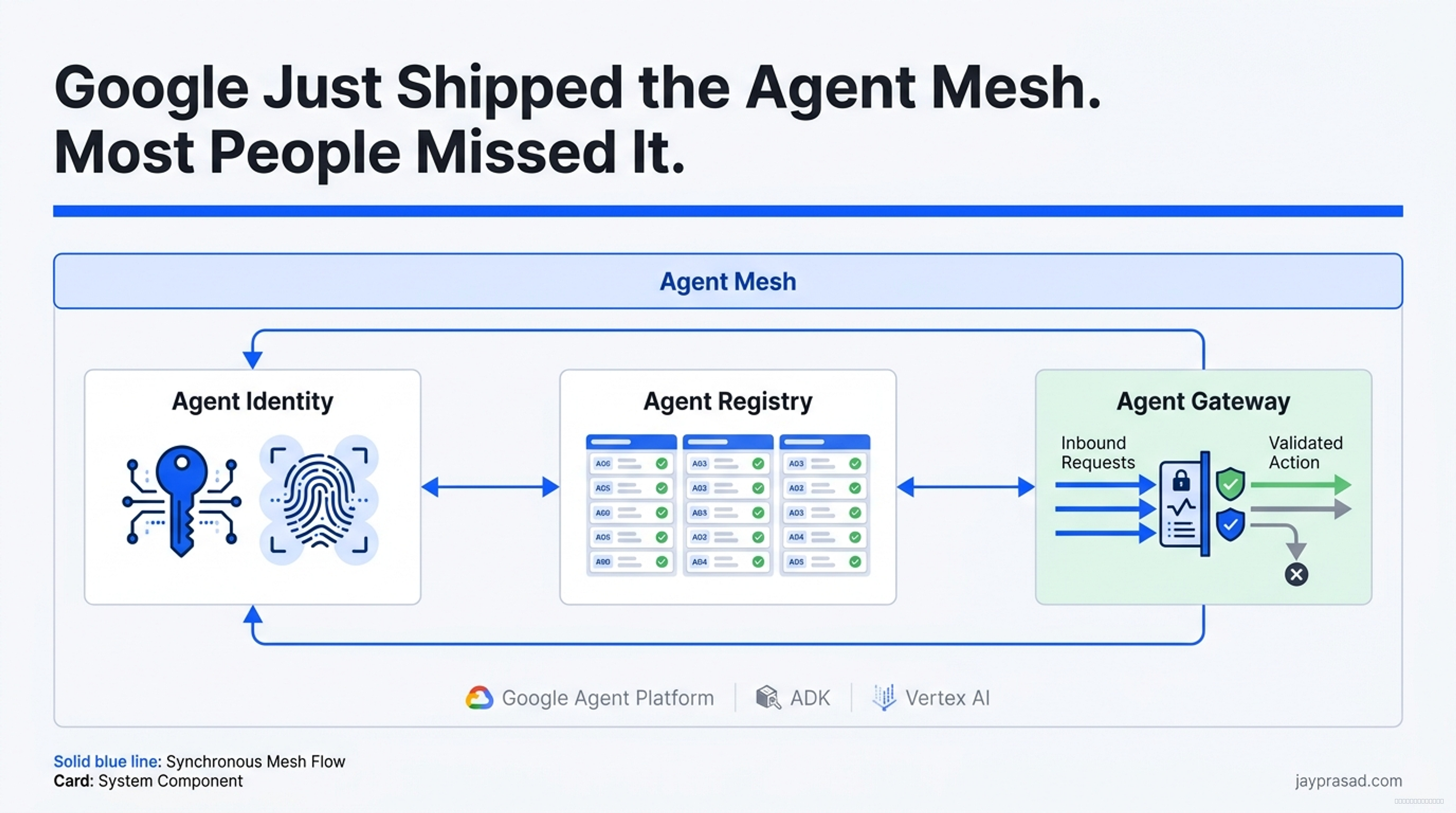
The real story in Google's Agent Platform isn't Gemini models, it's three governance primitives that form an agent mesh solving why enterprises can't get agents past POC.
Core argument
The short version of the piece before you go deeper.
The real story in Google's Agent Platform isn't Gemini models, it's three governance primitives that form an agent mesh solving why enterprises can't get agents past POC.
Watch the video
Google Just Shipped the Agent Mesh. Most People Missed It.
Everyone is talking about Gemini 2.5 Pro benchmarks. The real story is three infrastructure primitives that solve why enterprises can't get agents past POC.
Google's launch of the Gemini Enterprise Agent Platform is being covered as a platform rebrand. It isn't. It's the most consequential architectural decision in enterprise AI this year, and the part that matters most is the part getting the least attention.
The headline is that Vertex AI is being subsumed entirely. "All Vertex AI services and roadmap evolutions will be delivered exclusively through the Agent Platform, rather than as a standalone service." That's a forcing function, not a feature announcement. But the real story is what Google shipped underneath: a governance layer that treats agents as managed entities with cryptographic identities, centralized registries, and policy-enforced traffic control.
This is the agent mesh. And it changes the deployment calculus for every enterprise stuck in agent POC purgatory.
The Governance Gap Is the Real Blocker
Ask any CTO why their agent pilots haven't gone to production. The answer is almost never "the model isn't good enough." It's one of these:
- Who authorized that agent to access customer data?
- How do we audit what it did at 2 AM on a Saturday?
- What happens when it calls an external API we haven't vetted?
- How do we revoke access without taking down the whole system?
These are governance problems, not AI problems. And until last week, no major cloud provider had shipped a platform-native answer.
The contrarian take: Enterprise agent adoption isn't blocked by model capability. It's blocked by the absence of infrastructure that lets security teams say "yes." Google just built that infrastructure.
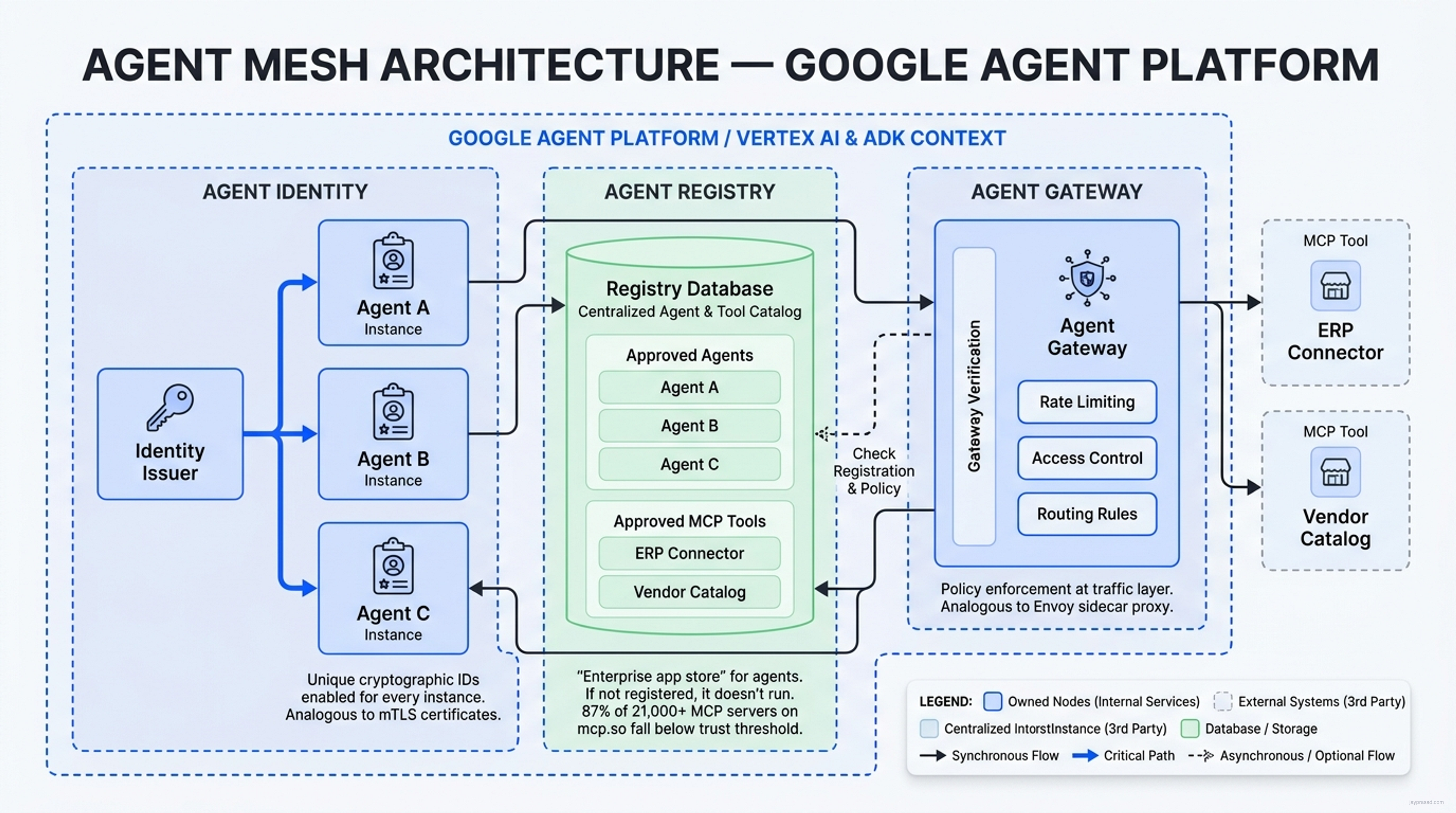
Google's answer comes in three primitives that work together:
Agent Identity
Every agent instance gets a unique cryptographic ID. This creates an auditable trail for every action, mapped to authorization policies. This functions as IAM for agents, except the principal isn't a human or a service account. It's an autonomous entity that makes decisions.
Agent Registry
A centralized catalog of approved agents and tools. This is the enterprise app store concept applied to agents: if it's not in the registry, it doesn't run. Roughly 87% of the 21,000+ MCP servers listed on mcp.so fall below a "high-trust threshold." Curation isn't optional. It's existential.
Agent Gateway
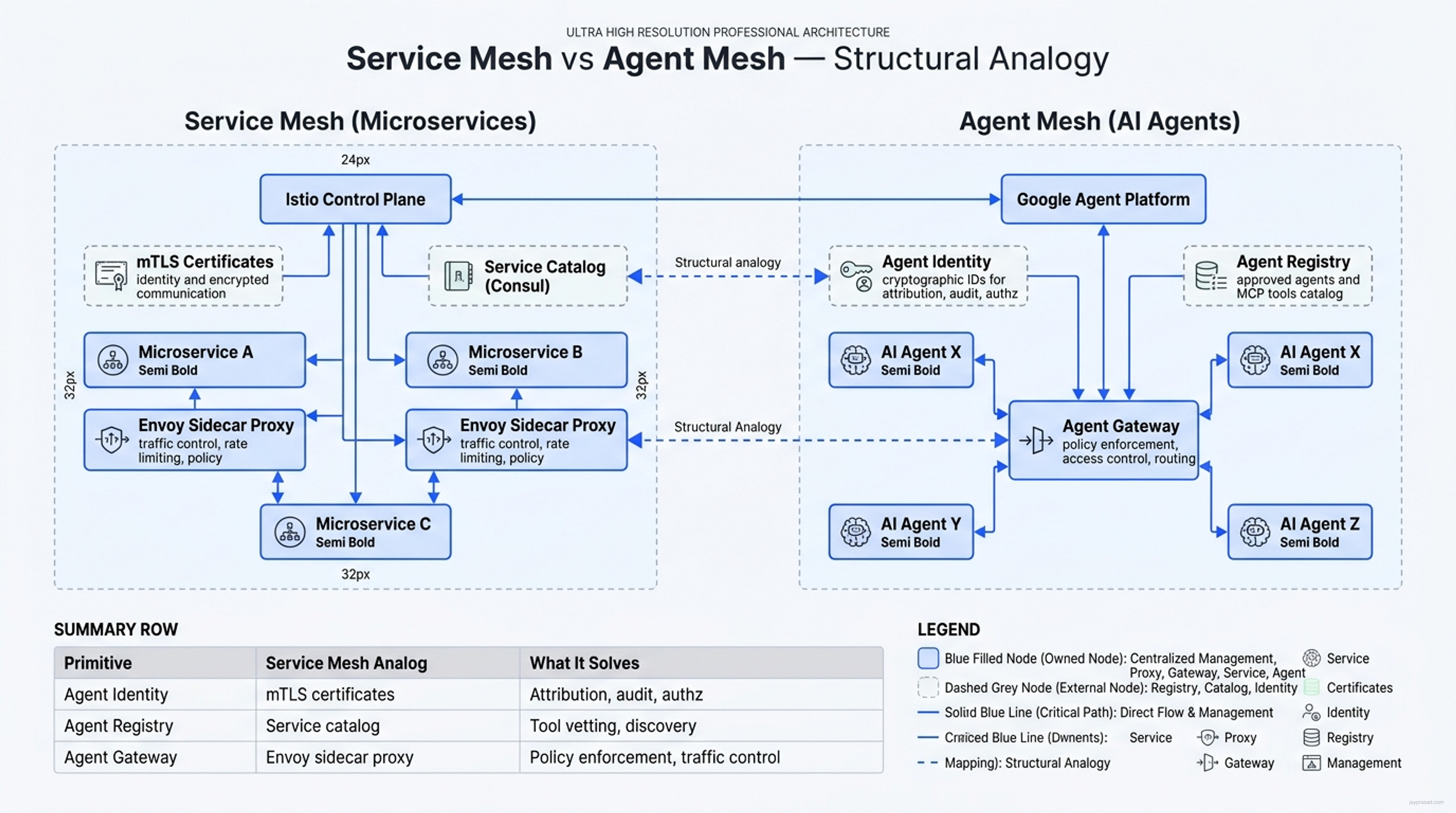
Policy enforcement at the traffic layer. Rate limiting, access control, routing rules, all applied to agent-to-agent and agent-to-tool communication. This is where the service mesh analogy becomes precise: Agent Gateway is to agents what Istio is to microservices.
| Primitive | Service Mesh Analog | What It Solves |
|---|---|---|
| Agent Identity | mTLS certificates | Attribution, audit, authz |
| Agent Registry | Service catalog | Tool vetting, discovery |
| Agent Gateway | Envoy sidecar proxy | Policy enforcement, traffic control |
Together, these three primitives form an agent mesh, the governance infrastructure layer that's been conspicuously absent from every competing framework.
The Competitive Picture Just Changed
Let's be precise about where this leaves the other hyperscalers and platform vendors.
| Platform | Agent Building | Governance Stack | Agent Commerce | Persistent Memory |
|---|---|---|---|---|
| Google Agent Platform | ADK (6T tokens/mo) | Agent Identity + Registry + Gateway | AP2 (PayPal) | Memory Bank |
| AWS Bedrock Agents | Yes | IAM-based (no agent-native) | None | Session-only |
| Azure AI Agent Service | Yes | Entra ID integration | None | Limited |
| Salesforce Agentforce | Yes (low-code focus) | Trust Layer | Commerce Cloud | CRM-scoped |
AWS and Azure offer agent-building capabilities. Neither has shipped a comparable governance stack as a platform primitive. Salesforce has a trust layer, but it's scoped to CRM workflows, not general-purpose agent orchestration.
Key warning: Google has shipped the most complete governance layer available today. But the hard lessons about what breaks when agents transact, remember, and operate autonomously at enterprise scale haven't been learned yet, by anyone. Adopting this platform means accepting that failure modes are still being discovered in production.
The six trillion tokens processed monthly through ADK is the number that separates this from vaporware. That's hyperscale production traffic. Not a demo.
Memory Bank: The Feature Everyone Is Underselling
Most coverage buries Memory Bank as a bullet point. It's not a bullet point. It's the architectural difference between a chatbot and a colleague.
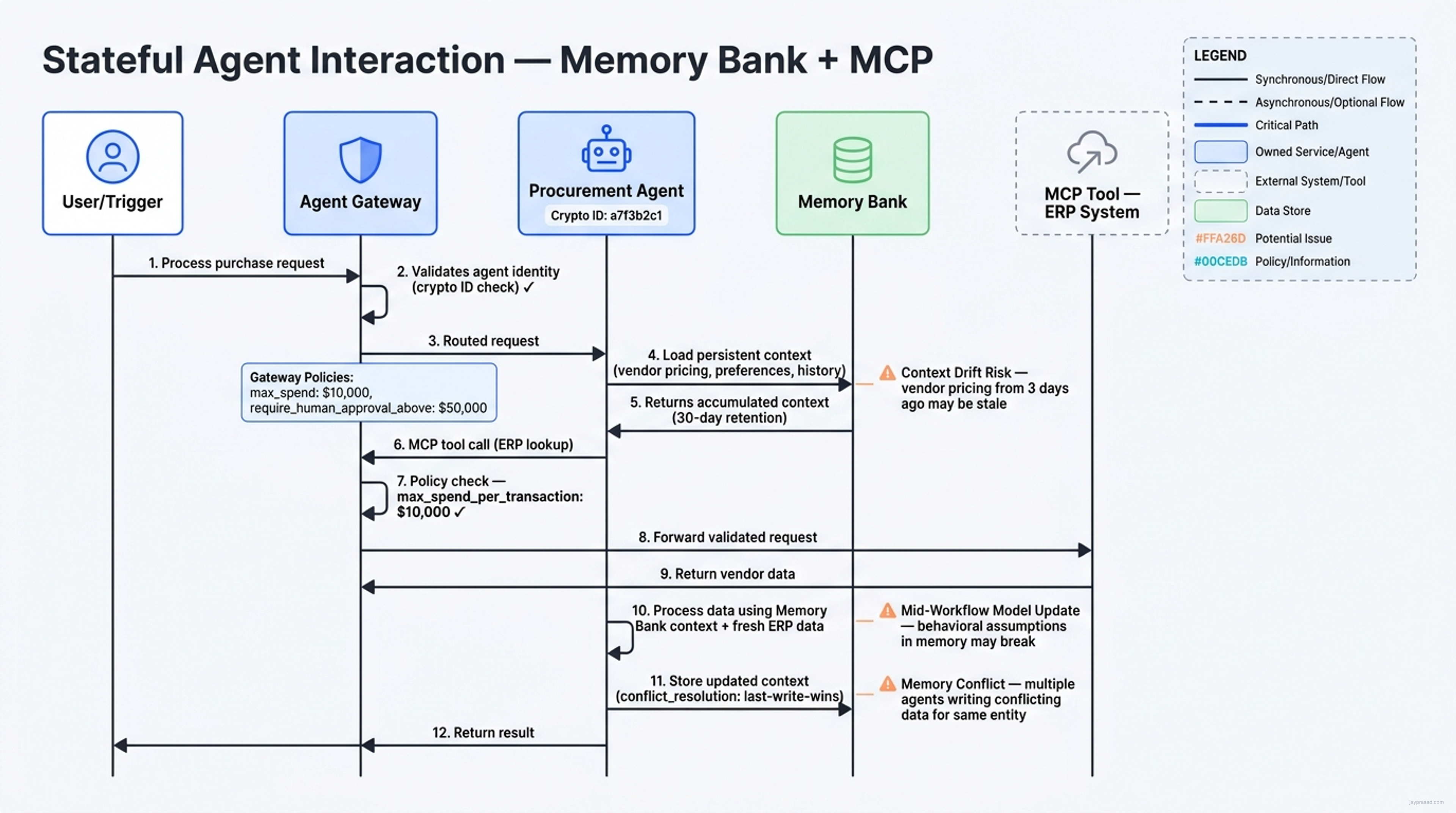
Memory Bank lets agents retain user context across days and sessions. Not just conversation history, but preferences, behavioral patterns, workflow state. Payhawk reports a 50% reduction in expense submission time. Gurunavi projects a 30% improvement in customer satisfaction.
Here's why this matters architecturally: a stateless agent is a fancy API endpoint. A stateful agent with persistent memory is a long-running process that accumulates institutional knowledge. That's a fundamentally different thing to operate.
The Failure Modes Nobody Is Talking About
Persistent agent memory introduces failure modes that don't exist in stateless architectures:
- Context drift: Over multi-day workflows, accumulated context can diverge from ground truth. A procurement agent that "remembers" a vendor's pricing from three days ago may act on stale data. That's a real problem.
- Memory conflicts: When multiple agents share context about the same entity, conflicting memory entries create consistency problems with no established resolution pattern.
- Mid-workflow model updates: If the underlying model gets updated while an agent is mid-workflow, behavioral assumptions encoded in memory may no longer hold.
No production benchmarks or post-mortem data exist for these scenarios. Zero. This is uncharted territory, and enterprise architects need to build their own safety margins.
What a Memory-Aware Agent Looks Like
The MCP integration is how agents connect persistent memory to enterprise data. L'Oréal's implementation illustrates the pattern: "Through Model Context Protocol (MCP), they are securely connected to our single sources of truth, including our Beauty Tech Data Platform and core operational applications."
# Conceptual agent configuration with Memory Bank
agent:
  id: procurement-agent-na-west
  identity: crypto-id-a7f3b2c1
  memory:
    backend: memory-bank
    retention: 30d
    conflict_resolution: last-write-wins  # ← this needs work
  tools:
    - registry: approved-tools/procurement
    - mcp_connections:
        - erp.internal.company.com
        - vendor-catalog.internal.company.com
  gateway_policies:
    - max_spend_per_transaction: 10000
    - require_human_approval_above: 50000
That conflict_resolution: last-write-wins is doing a lot of hand-waving. Enterprise architects should pressure Google on this before committing stateful workloads.
Agent Payments: The Primitive Nobody Else Has
Agent Payment Protocol (AP2) is the most commercially significant and least explored dimension of this announcement. PayPal's endorsement is explicit: "Agent Payment Protocol (AP2) on Agent Platform provides the critical foundation for trusted agent payments."
If agents are going to autonomously transact, purchasing cloud resources, processing invoices, managing SaaS subscriptions, the payment infrastructure needs to be purpose-built for machine-to-machine trust. Human e-commerce flows assume a human is reviewing a cart, confirming a total, entering credentials. Agent commerce has none of those checkpoints. None.
Unanswered Questions Enterprise Architects Must Ask
- How does AP2 handle PCI DSS compliance for agent-initiated transactions?
- What fraud detection models exist for non-human transaction patterns?
- Where does liability sit when an agent makes an autonomous purchasing error?
- How are spending limits enforced across multi-agent orchestration chains?
- What happens when an agent's cryptographic identity is compromised mid-transaction?
- How do chargebacks work when neither party is human?
None of these have public answers yet. PayPal's involvement suggests they're being worked on, but if you're deploying agent commerce workflows, you're building on infrastructure whose edge cases are still being defined. Eyes open.
The Lock-In Question Deserves More Scrutiny
Google's decision to sunset standalone Vertex AI is a forcing function. Every existing Vertex AI customer is now on the Agent Platform path whether they planned for it or not.
But there's a subtler lock-in risk that goes beyond infrastructure: context lock-in.
When your agents accumulate months of conversation history, user preferences, evaluation data, and workflow state in Memory Bank, that persistent context becomes a migration barrier that's qualitatively different from switching cloud providers. You can re-deploy a model anywhere. You can't easily port an agent's institutional memory. That's the trap.
Evaluating Lock-In Risk
- Audit what data flows into Memory Bank vs. your own data stores
- Ensure MCP connections point to your data platforms, not Google-hosted intermediaries
- Build export pipelines for agent memory and evaluation data from day one
- Test agent portability by running the same agent definition on ADK open-source locally
- Negotiate contractual data portability terms before committing production workloads
The open-source ADK release mitigates some of this. You can run agents outside Google Cloud. But Memory Bank, Agent Registry, and Agent Gateway are platform services. The governance layer that makes agents production-ready is the same layer that creates dependency. Worth thinking about early.
What Comcast and L'Oréal Tell Us About Production Readiness
Two case studies stand out. Comcast rebuilt its Xfinity Assistant on ADK, moving "beyond simple scripted automation to conversational generative intelligence." L'Oréal connected agents to its Beauty Tech Data Platform via MCP.
These aren't POCs. They're production deployments at companies with hundreds of millions of customers. That matters because it establishes a baseline: the platform can handle enterprise-scale traffic with real data integration requirements.
But notice what's absent from both case studies: multi-agent orchestration, autonomous transactions, and multi-day stateful workflows. The production-proven surface area is single-agent, human-supervised, session-scoped. The ambitious features, agent mesh governance, AP2 payments, Memory Bank persistence, are the new frontier. We don't have war stories yet.
Implications for Enterprise Architects
Google has made the most aggressive platform consolidation move in enterprise AI. The agent mesh primitives are genuinely novel. The commerce layer is first-of-its-kind. The persistent memory capability is a real differentiator.
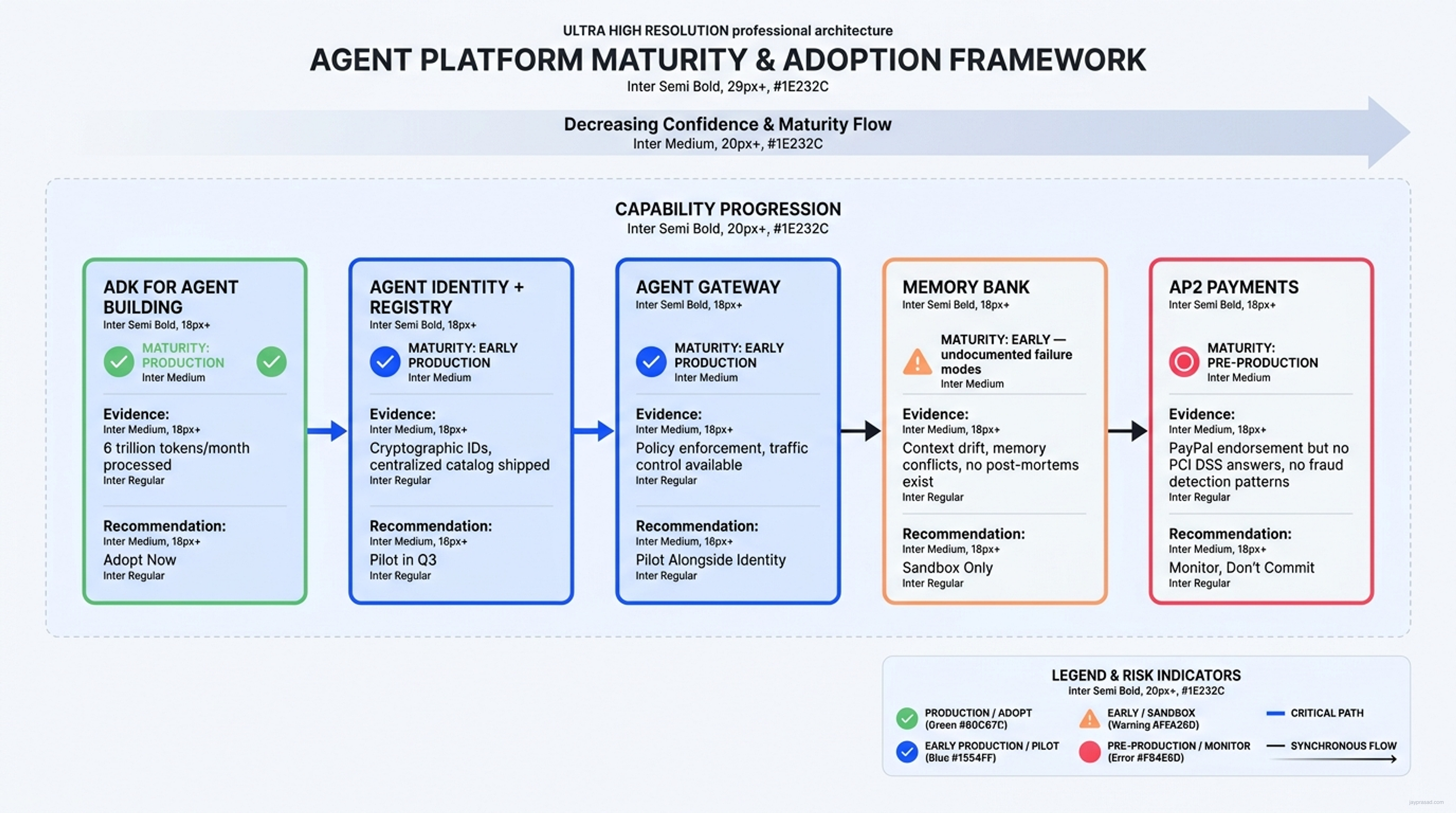
But the maturity curve is uneven. Here's how I'd think about adoption:
| Capability | Maturity | Recommendation |
|---|---|---|
| ADK for agent building | Production (6T tokens/mo) | Adopt now |
| Agent Identity + Registry | Early production | Pilot in Q3 |
| Agent Gateway | Early production | Pilot alongside Identity |
| Memory Bank | Early, undocumented failure modes | Sandbox only |
| AP2 Payments | Pre-production | Monitor, don't commit |
The agent mesh is the real story. It solves the governance gap that's kept enterprises in POC purgatory. But the hardest problems, stateful failure modes, autonomous transaction liability, context lock-in, are still being discovered.
Build on the governance layer. Pressure-test the stateful features. And keep your data in your own systems, connected via MCP, not stored in someone else's Memory Bank.
The agents are coming to production. The question is whether the infrastructure underneath them is ready for what happens when they get there.
Discussion
Responses, reactions, and open questions.
The article stays static. The conversation sits underneath it. Sign in with your email, react to the argument, and join the discussion.
Join the discussion
Use your email to get a one-time sign-in code. First comments may wait in moderation before they appear publicly.