ChatGPT Astra vs Claude Fable 5.1: They're Not Competing Anymore
Astra and Fable 5.1 have diverged so fundamentally that comparing them on benchmarks misses the point - route by workload, not leaderboard.
Core argument
The short version of the piece before you go deeper.
Astra and Fable 5.1 have diverged so fundamentally that comparing them on benchmarks misses the point - route by workload, not leaderboard.
# ChatGPT Astra vs Claude Fable 5.1: They're Not Competing Anymore
The most common question I'm hearing from engineering leads right now: "Should we use ChatGPT Astra or Claude Fable 5.1?" It's the wrong question. These models have diverged so fundamentally that a side-by-side benchmark comparison misses the architectural reality. OpenAI and Anthropic are no longer optimizing for the same axis. Understanding where they diverged matters more than which scores higher on a leaderboard.
The contrarian take: Treating Astra and Fable 5.1 as interchangeable options is like comparing a real-time streaming engine to a batch analytics platform. They solve different problems. Pick based on workload, not vibes.
---
The Divergence Is the Story
ChatGPT Astra is OpenAI's bet on real-time multimodal interaction. It processes voice, vision, and text in a unified streaming pipeline. Think of it as a model optimized for live engagement—customer-facing agents, real-time video analysis, voice-driven workflows.
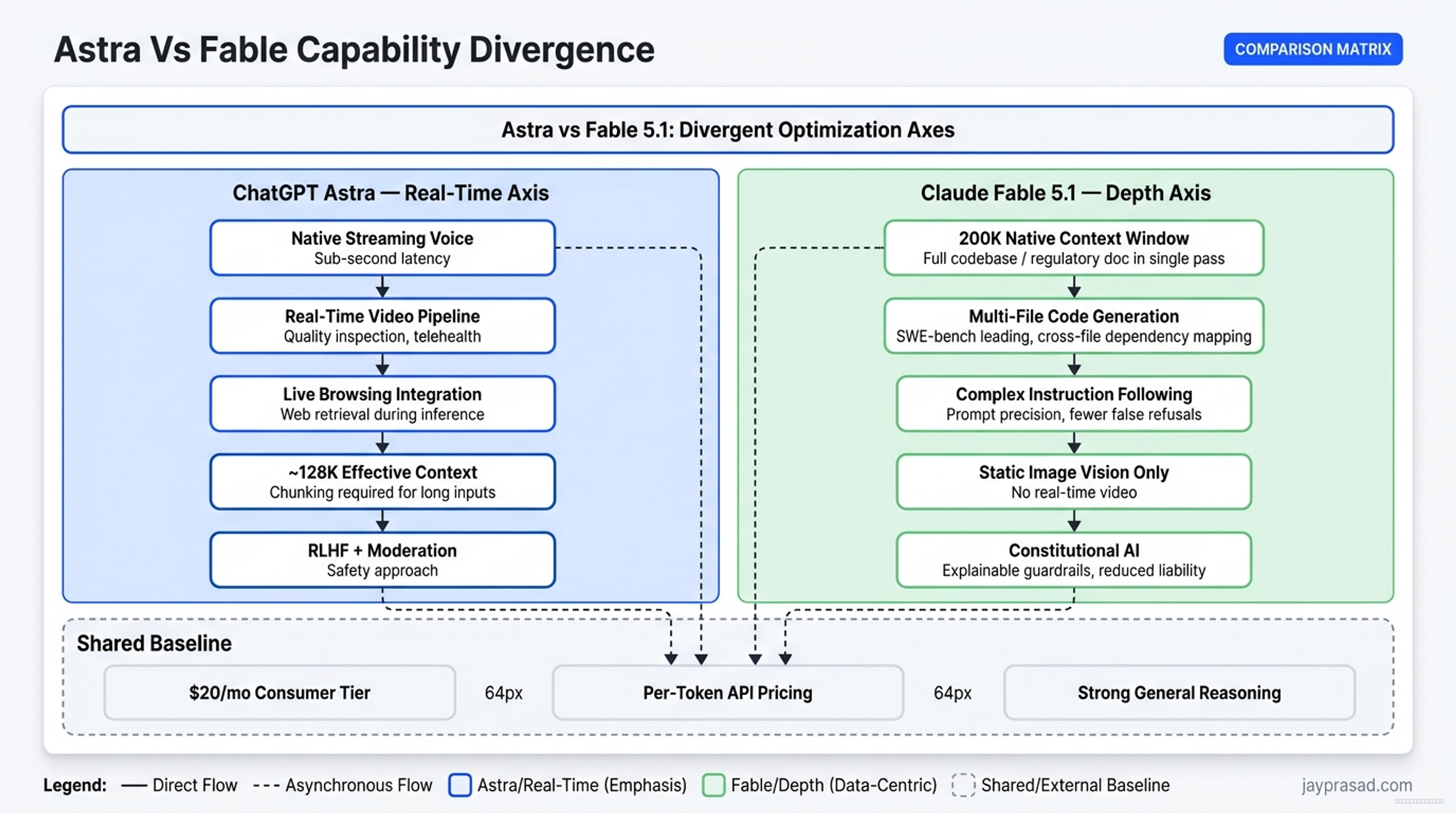
Claude Fable 5.1 is Anthropic's bet on deep reasoning and instruction fidelity. It extends the Sonnet/Opus lineage with a 200K-token context window, improved multi-file code generation, and a refined Constitutional AI safety layer that reduces false refusals.
These aren't incremental upgrades. They represent two different theories about what enterprise AI should do.
Where Each Model Leads
| Capability | ChatGPT Astra | Claude Fable 5.1 |
|---|---|---|
| Context window | ~128K effective | 200K native |
| Real-time voice | Native, streaming | Not supported |
| Vision input | Real-time video | Static images only |
| Code generation | Strong | Best-in-class |
| Instruction following | Good | Excellent |
| Safety approach | RLHF + moderation | Constitutional AI |
The context window gap alone changes what's architecturally possible. 200K tokens means Fable 5.1 can ingest an entire codebase or a full regulatory document in a single pass. Astra's 128K is still substantial, but it forces chunking strategies for longer inputs.
---
ChatGPT Astra: Built for Real-Time
Astra's standout capability is its native real-time audio and video processing pipeline. This isn't a bolted-on feature. The model processes multimodal streams natively, which means latency stays low enough for live interaction.
Where Astra Wins
- Voice-driven customer agents that need sub-second response times
- Live video analysis—quality inspection, security monitoring, telehealth
- Browsing integration for real-time information retrieval during conversations
- Consumer-facing products where UX fluidity matters more than reasoning depth
For teams building products that interact with humans in real time, Astra is the obvious choice. No other model offers this combination of modalities at this latency.
The Tradeoff
Astra's real-time optimization comes at a cost. Its reasoning depth on complex, multi-step problems doesn't match Fable 5.1. If you're routing a 50-file pull request through the model or asking it to reason across a 150-page contract, you'll hit limits faster.
---
Claude Fable 5.1: Built for Depth
Fable 5.1 continues Anthropic's pattern of winning on tasks that require sustained reasoning over long contexts. The SWE-bench results tell the story: Claude models have historically outperformed GPT-class models on coding benchmarks. Fable 5.1 extends that lead with reported gains in multi-file code generation.
Where Fable 5.1 Wins
- Enterprise code generation across large repositories
- Document analysis requiring full-context reasoning (legal, compliance, financial)
- Complex instruction following where prompt precision matters
- Safety-sensitive deployments where Constitutional AI reduces liability
Key insight: Fable 5.1's Constitutional AI approach produces noticeably fewer false refusals on nuanced prompts compared to earlier Claude versions. This matters in enterprise settings where a model refusing a legitimate medical, legal, or financial query creates real operational friction.
The Code Generation Gap
Here's a concrete example. Ask both models to refactor a service with dependencies across multiple files:
// Prompt: Refactor this payment service to use
// the new event-driven architecture. The service
// spans these files: payment.ts, ledger.ts,
// notification.ts, and audit.ts.

// Fable 5.1 consistently:
// 1. Maps cross-file dependencies first
// 2. Proposes a migration sequence
// 3. Generates coordinated changes across all files
// 4. Flags breaking changes in downstream consumers

// Astra typically:
// 1. Refactors each file independently
// 2. Requires follow-up prompts for coordination
// 3. Misses some cross-file dependency edges
This isn't a knock on Astra. It's a reflection of optimization priorities. Astra is optimized for responsiveness. Fable 5.1 is optimized for thoroughness.
---
Pricing: Similar Entry, Different Scaling
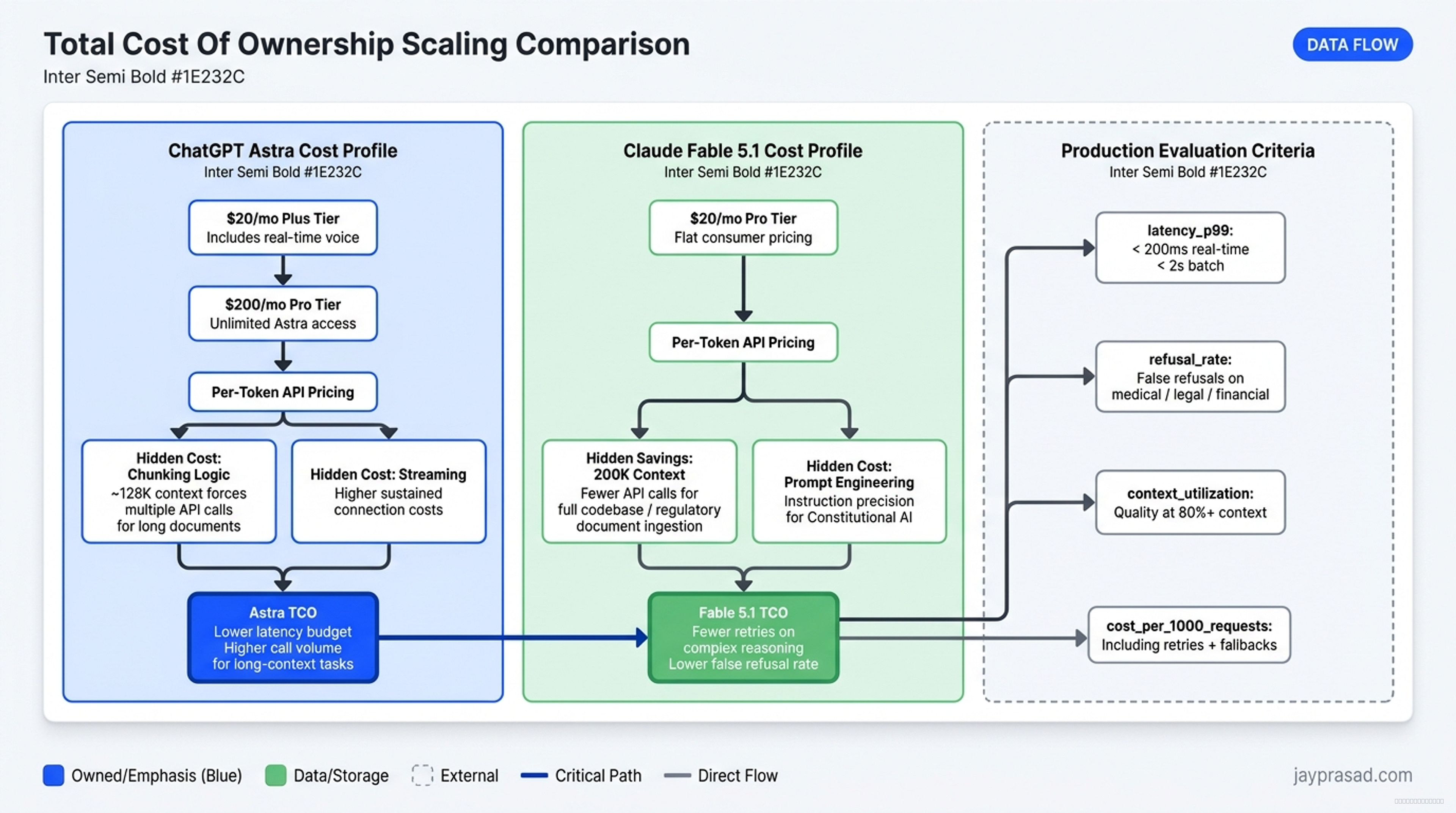
Both companies offer a $20/month consumer tier. The economics diverge at scale.
| Tier | ChatGPT Astra | Claude Fable 5.1 |
|---|---|---|
| Consumer | $20/mo (Plus) | $20/mo (Pro) |
| Power user | $200/mo (Pro) | $20/mo (Pro) |
| API pricing | Per-token | Per-token |
| Real-time voice | Included in Plus | N/A |
OpenAI's $200/month Pro tier unlocks unlimited access to Astra's full capabilities. Anthropic keeps things simpler with a flat Pro tier and per-token API pricing. For API-heavy workloads, the per-token math depends entirely on your volume and context length.
The Hidden Cost
The real pricing question isn't per-token rates. It's total cost of ownership when you factor in prompt engineering, retry logic, and context management. Fable 5.1's longer context window means fewer API calls for long-document tasks. Astra's real-time streaming means higher sustained connection costs but lower latency budgets.
---
How to Choose: A Decision Framework for ChatGPT Astra vs Claude Fable 5.1
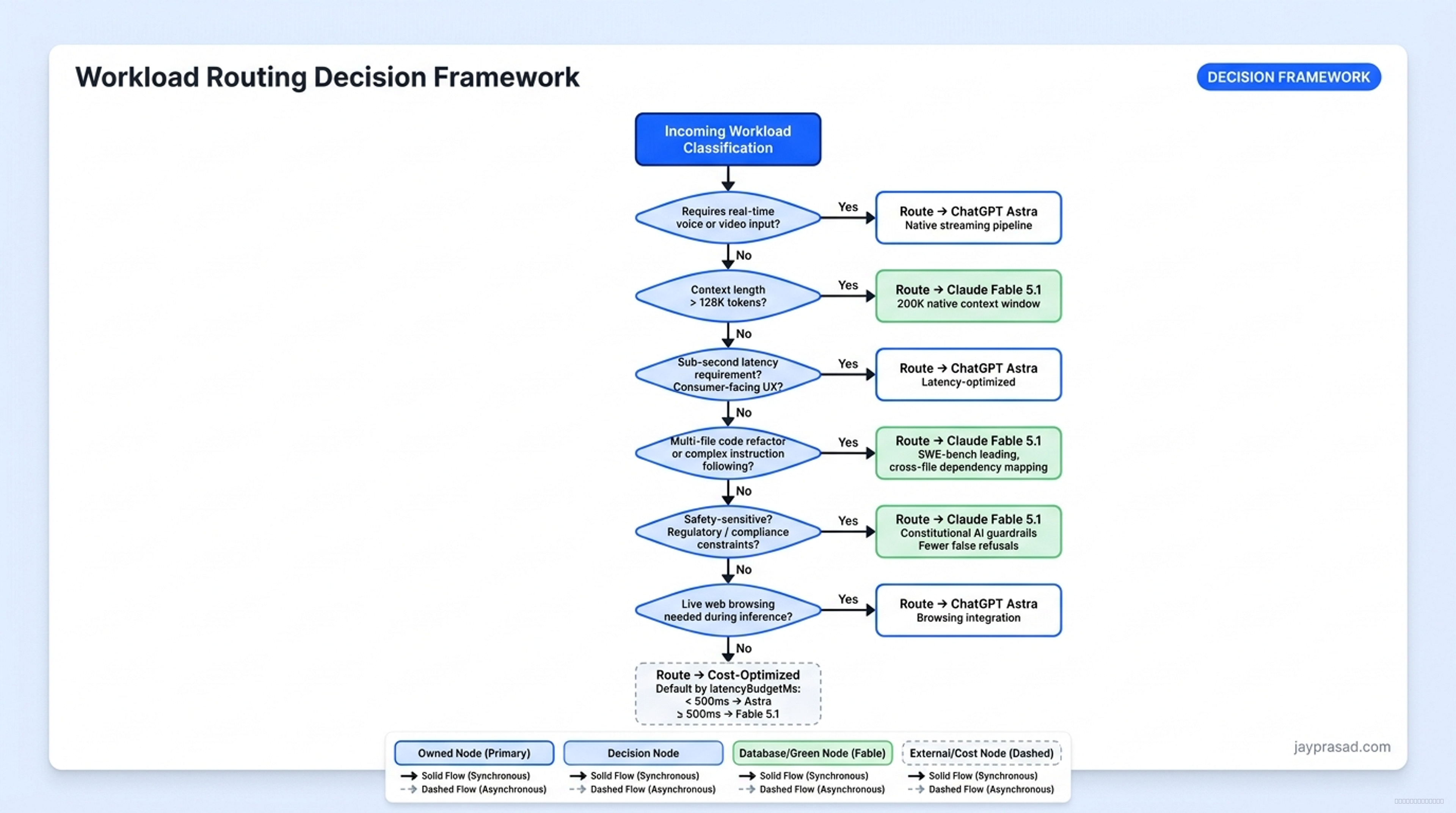
Stop comparing benchmarks. Start with the workload. Here's the evaluation framework I'd use:
Step 1: Classify the Workload
- [ ] Does the use case require real-time voice or video input?
- [ ] Does the task involve reasoning over >128K tokens of context?
- [ ] Is the output consumer-facing with sub-second latency requirements?
- [ ] Does the task involve multi-file code generation or complex refactoring?
- [ ] Are there regulatory or safety constraints that demand explainable guardrails?
- [ ] Will the system need to browse live web content during inference?
If you checked the first, third, or sixth boxes, lean Astra. If you checked the second, fourth, or fifth, lean Fable 5.1.
Step 2: Test Against Production Payloads
Benchmarks are synthetic. Run both models against your actual data. Measure what matters for your system:
evaluation_criteria:
  latency_p99: "< 200ms for real-time, < 2s for batch"
  accuracy_on_domain_tasks: "measured against human baseline"
  refusal_rate: "false refusals on legitimate queries"
  context_utilization: "quality degradation at 80%+ context"
  cost_per_1000_requests: "including retries and fallbacks"
Step 3: Build for Both
This is the part most teams skip. The models are diverging. The smart architectural move is to converge around that reality.
---
The Real Play: Model-Agnostic Orchestration
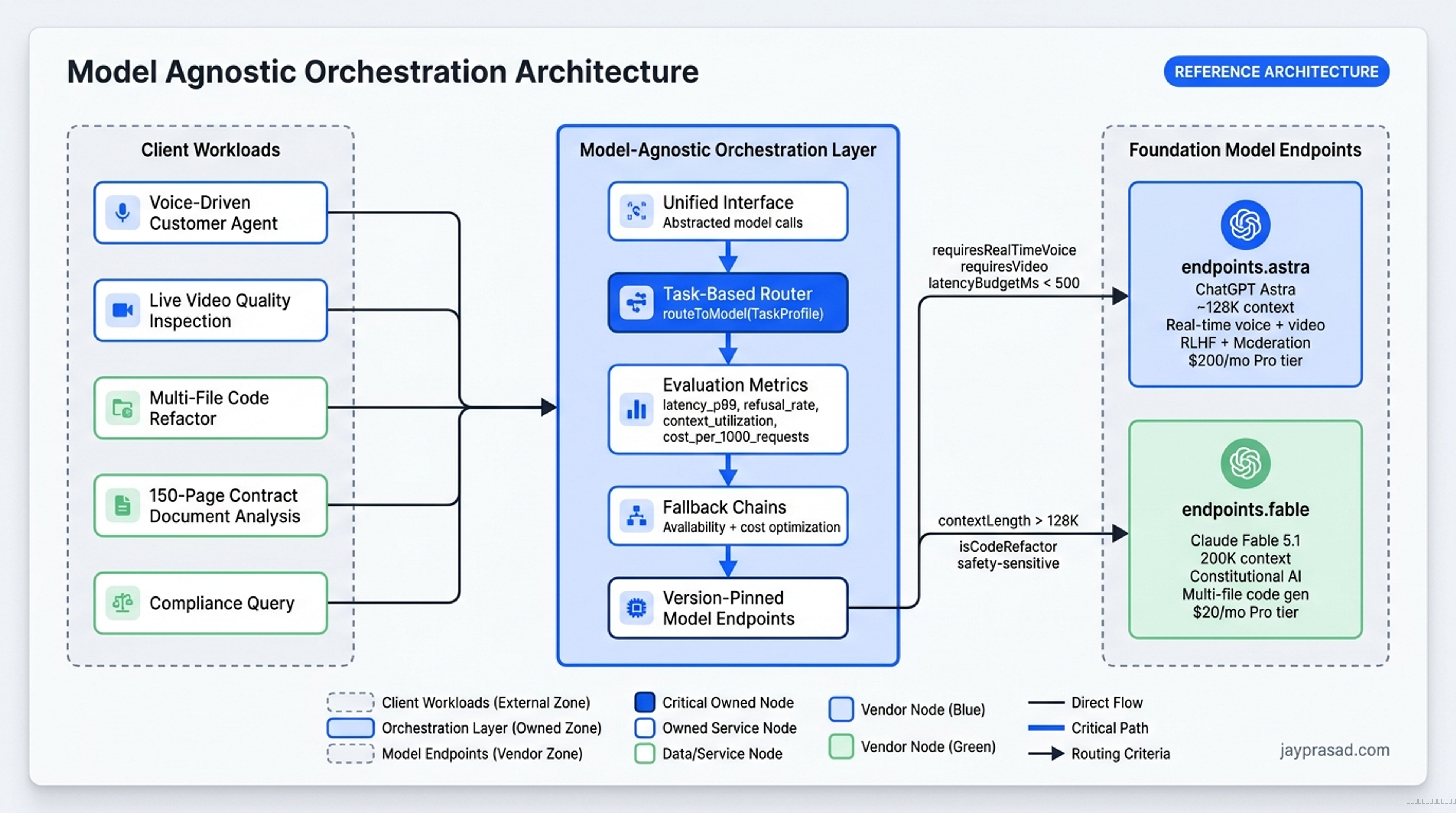
Here's what I'd actually recommend. Don't pick one. Build an orchestration layer that routes to the right model based on task characteristics.
The teams that will win are the ones building model-agnostic orchestration layers now. This isn't theoretical—it's practical engineering.
- [ ] Abstract model calls behind a unified interface
- [ ] Implement task-based routing (real-time → Astra, deep reasoning → Fable)
- [ ] Standardize evaluation metrics across models
- [ ] Build fallback chains for availability and cost optimization
- [ ] Version-pin model endpoints to prevent surprise behavior changes
// Simplified routing logic
function routeToModel(task: TaskProfile): ModelEndpoint {
  if (task.requiresRealTimeVoice || task.requiresVideo) {
    return endpoints.astra;
  }
  if (task.contextLength > 128_000 || task.isCodeRefactor) {
    return endpoints.fable;
  }
  // Default to cost-optimized option
  return task.latencyBudgetMs < 500
    ? endpoints.astra
    : endpoints.fable;
}
This pattern isn't new. It's the same principle behind database selection (OLTP vs. OLAP) and compute orchestration (GPU vs. CPU). The AI model layer is simply catching up to the same architectural maturity.
---
What This Means for Enterprise AI Strategy
The ChatGPT Astra vs Claude Fable 5.1 comparison reveals something bigger than model selection. It signals that the foundation model market is specializing. The era of one-model-fits-all is ending.
For enterprise teams, the implications are clear:
- Vendor lock-in risk is rising. Each model's unique capabilities create switching costs. Astra's real-time voice pipeline has no direct equivalent. Fable 5.1's 200K context window changes what's possible in document processing.
- Evaluation frameworks need updating. Single-score benchmarks can't capture the divergence. Teams need task-specific evaluation suites.
- Orchestration is the new moat. The competitive advantage isn't which model you use. It's how intelligently you route between them.
The models are diverging. The architecture should converge around that reality—with abstraction layers that treat models as interchangeable compute resources, routed by workload characteristics rather than brand loyalty.
That's not a prediction. It's already happening in every serious AI engineering team I talk to.
Discussion
Responses, reactions, and open questions.
The article stays static. The conversation sits underneath it. Sign in with your email, react to the argument, and join the discussion.
Join the discussion
Use your email to get a one-time sign-in code. First comments may wait in moderation before they appear publicly.