Stop Hiring AI Engineers. Design Your AI Team First.
CTOs who hire AI talent without a structural blueprint waste 6-12 months on misaligned teams that can't ship to production.
Core argument
The short version of the piece before you go deeper.
CTOs who hire AI talent without a structural blueprint waste 6-12 months on misaligned teams that can't ship to production.
# Stop Hiring AI Engineers. Design Your AI Team First.
Here's my take: the reason 74% of enterprises can't move AI pilots to production isn't a technology problem. It's an AI team design problem. Most CTOs I talk to start by opening headcount reqs for ML engineers. They should be starting with a blueprint for how capabilities stack, connect, and deliver outcomes. Hiring without that blueprint wastes 6-12 months and burns through seven-figure budgets on misaligned talent.
McKinsey's 2024 survey confirms this. Organizational misalignment — not technology limitations — is the top barrier to scaling AI. That finding should reframe every conversation about "building an AI team."
The uncomfortable truth: You don't have a hiring problem. You have an org design problem wearing a hiring problem's clothes.
---
The Five Capability Layers Every AI Team Needs
Before you post a single job listing, map your capability stack. Every production AI system depends on five layers. Skip one, and you create a bottleneck that no amount of hiring can fix.
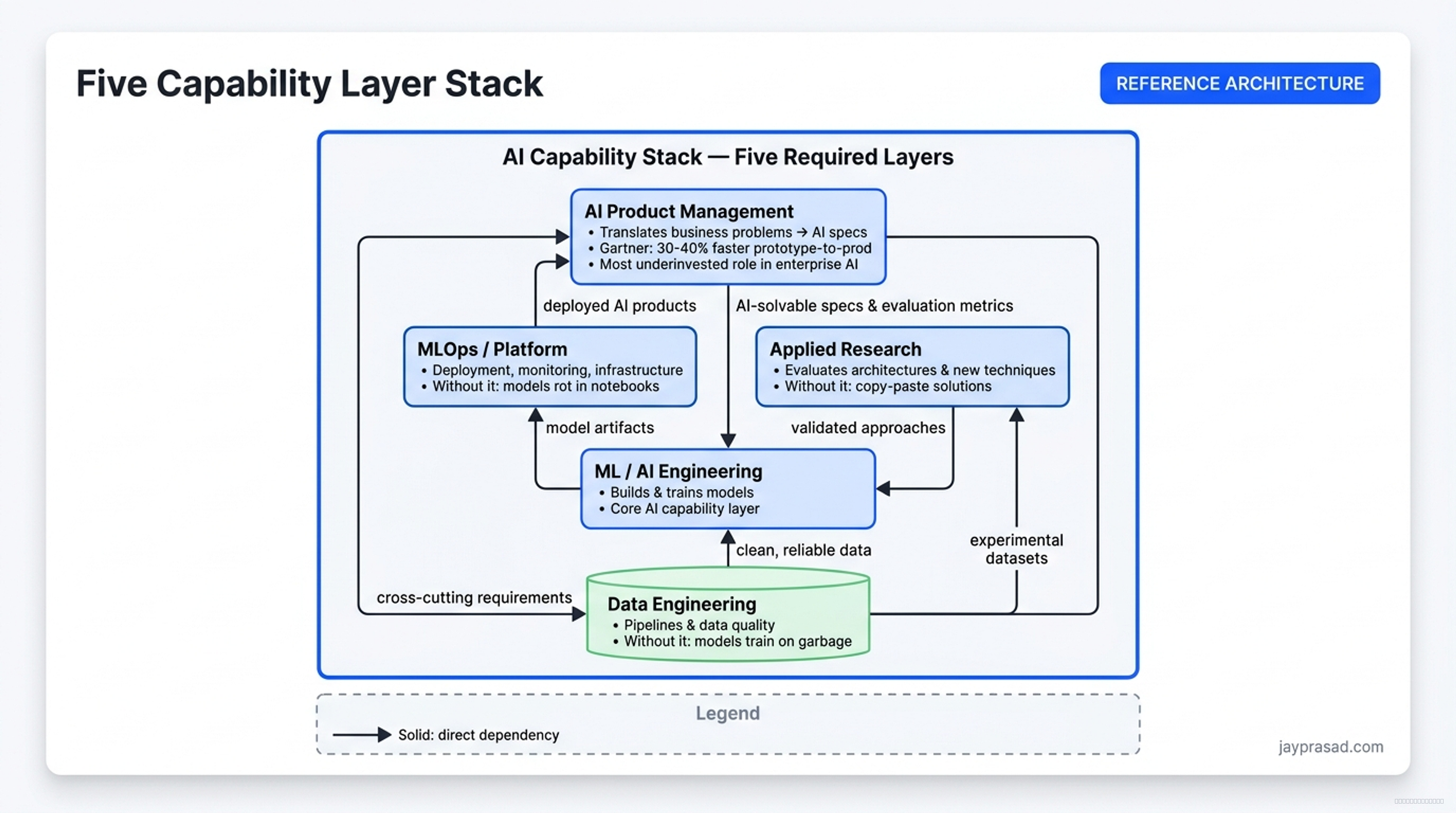
Here's what each layer does and what breaks without it.
Data Engineering builds pipelines and manages data quality. Without it, models train on garbage.
ML/AI Engineering builds and trains models. Without it, you have no core AI capability.
Applied Research explores new techniques and evaluates architectures. Without it, you copy-paste solutions that don't fit your domain.
MLOps/Platform handles deployment, monitoring, and infrastructure. Without it, models rot in notebooks and never reach production.
AI Product Management translates business problems into AI-solvable specs. Without it, engineers build impressive demos that solve the wrong problem.
The Layer Most Teams Skip
AI product management is the single most underinvested role in enterprise AI. These aren't traditional PMs who write user stories. They understand model limitations, data requirements, and evaluation metrics.
Gartner's 2024 data shows companies that add this function see 30-40% faster time from prototype to production. That's not incremental. That's the difference between shipping in Q2 and shipping in Q4.
Why this matters: An AI PM who can say "this problem isn't solvable with current data" saves more money than three ML engineers who build a model that proves it the hard way.
---
Google's "High-Debt ML" Warning Is Real
Google's MLOps research introduced the concept of high-debt ML systems. The pattern is predictable. You hire an ML engineer. They build a model. There's no data engineer to ensure pipeline reliability. There's no MLOps engineer to deploy and monitor it.
The result? A system that costs 2-5x more to maintain than it cost to build.
I've seen this play out repeatedly. A team ships a model in 8 weeks. Then spends 18 months patching data drift, retraining manually, and debugging pipeline failures at 2 AM.
The Dependency Chain
The fix is understanding the dependency chain between layers:
# AI Capability Dependencies
ai_team_dependencies:
  ml_engineering:
    requires:
      - data_engineering  # clean, reliable data
      - mlops_platform    # deployment target
    feeds:
      - ai_product_management  # model capabilities

  applied_research:
    requires:
      - data_engineering  # experimental datasets
    feeds:
      - ml_engineering    # validated approaches

  ai_product_management:
    requires:
      - all_layers        # cross-cutting function
    feeds:
      - business_units    # deployed AI products
Hire out of order, and you get expensive people waiting on infrastructure that doesn't exist.
---
Three Org Models: Pick Your Trade-offs
Once you've mapped your capability stack, you need a team structure — how these layers relate to the rest of the org. There are three dominant models. Each optimizes for something different. Each sacrifices something real.
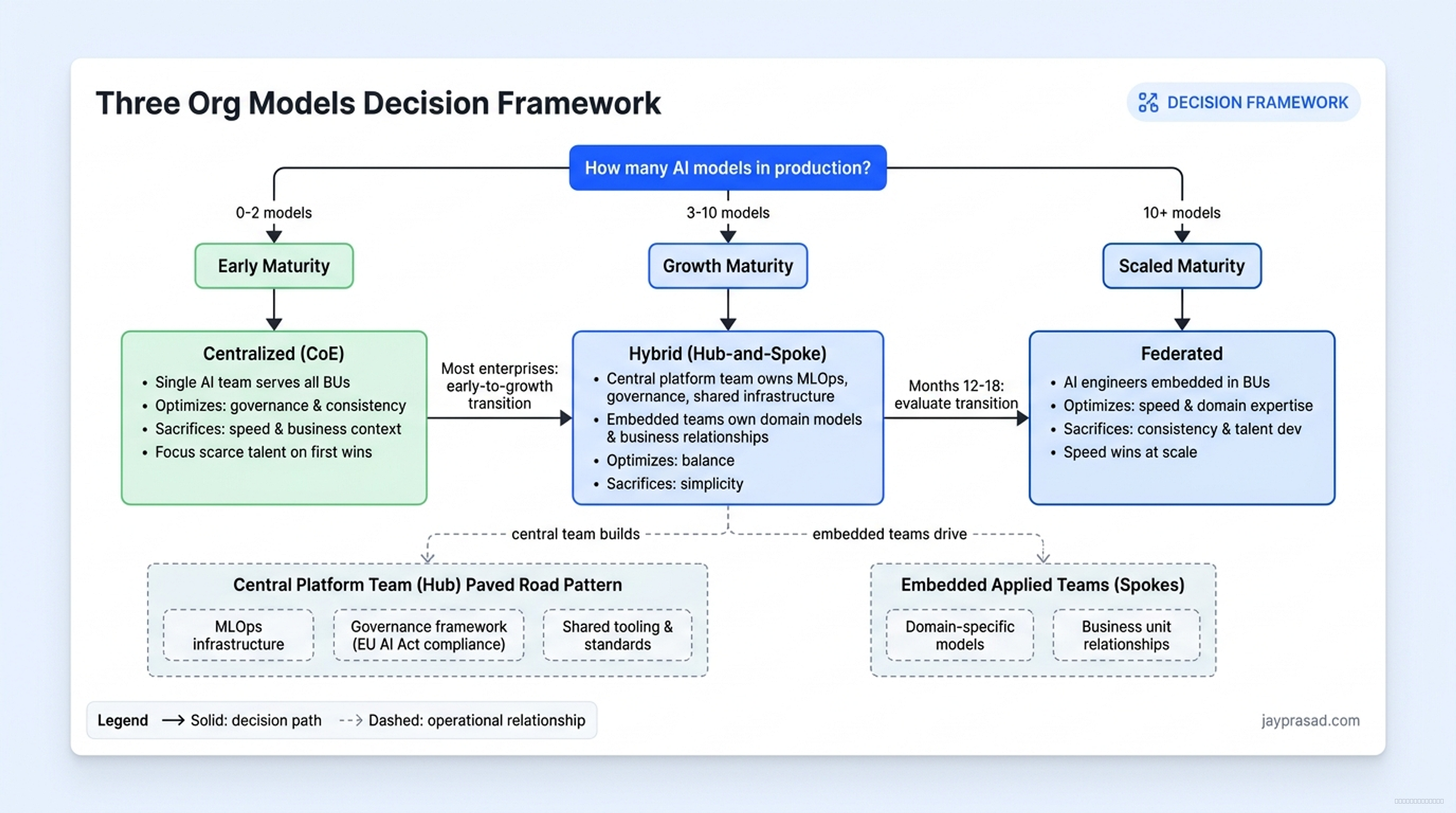
Centralized (CoE) puts a single AI team serving all business units. It optimizes for governance and consistency. It sacrifices speed and business context.
Federated embeds AI engineers directly in business units. It optimizes for speed and domain expertise. It sacrifices consistency and talent development.
Hybrid (Hub-and-Spoke) uses a central platform team with embedded applied teams. It optimizes for balance. It sacrifices simplicity.
Which Model Fits Your Enterprise?
The right answer depends on your AI maturity. Here's how I think about it:
| AI Maturity Stage | Best Model | Why |
|---|---|---|
| Early (0-2 models) | Centralized | Focus scarce talent |
| Growth (3-10 models) | Hybrid | Scale with guardrails |
| Scaled (10+ models) | Federated | Speed wins |
Most enterprises I work with are in the early-to-growth transition. That's where the hybrid model earns its complexity cost. You get a central platform team that owns MLOps, governance, and shared infrastructure. Embedded teams own domain-specific models and business relationships.
The architectural choice here mirrors what we see in platform engineering more broadly. The central team builds the paved road. Embedded teams drive on it.
---
AI Team Design Means Retention, Not Just Recruiting
Senior ML engineers now command $250K-$450K total comp in the US. At that price, losing one engineer costs you the equivalent of 6-9 months of productive output — between recruiting, onboarding, and ramp-up.
Retention strategy matters as much as recruiting strategy. Here's what actually works:
Career Ladders with IC Tracks
An ML engineer shouldn't have to become a manager to advance. Build Staff and Principal IC levels. Give them real scope and compensation parity with management.
Research Time Allocation
Google's 20% time is famous for a reason. Allocating 10-20% of time to research or open-source work keeps senior engineers engaged. It also produces innovations that feed back into production systems.
Open-Source Contribution Policies
Top ML engineers want to publish and contribute. A clear policy that allows this — with appropriate IP guardrails — is a retention tool that costs nothing.
- [ ] IC career ladder extends to Staff/Principal levels
- [ ] Research time policy (10-20%) is documented
- [ ] Open-source contribution policy exists with IP guidelines
- [ ] Compensation bands reviewed quarterly against market
- [ ] Internal mobility paths between capability layers defined
---
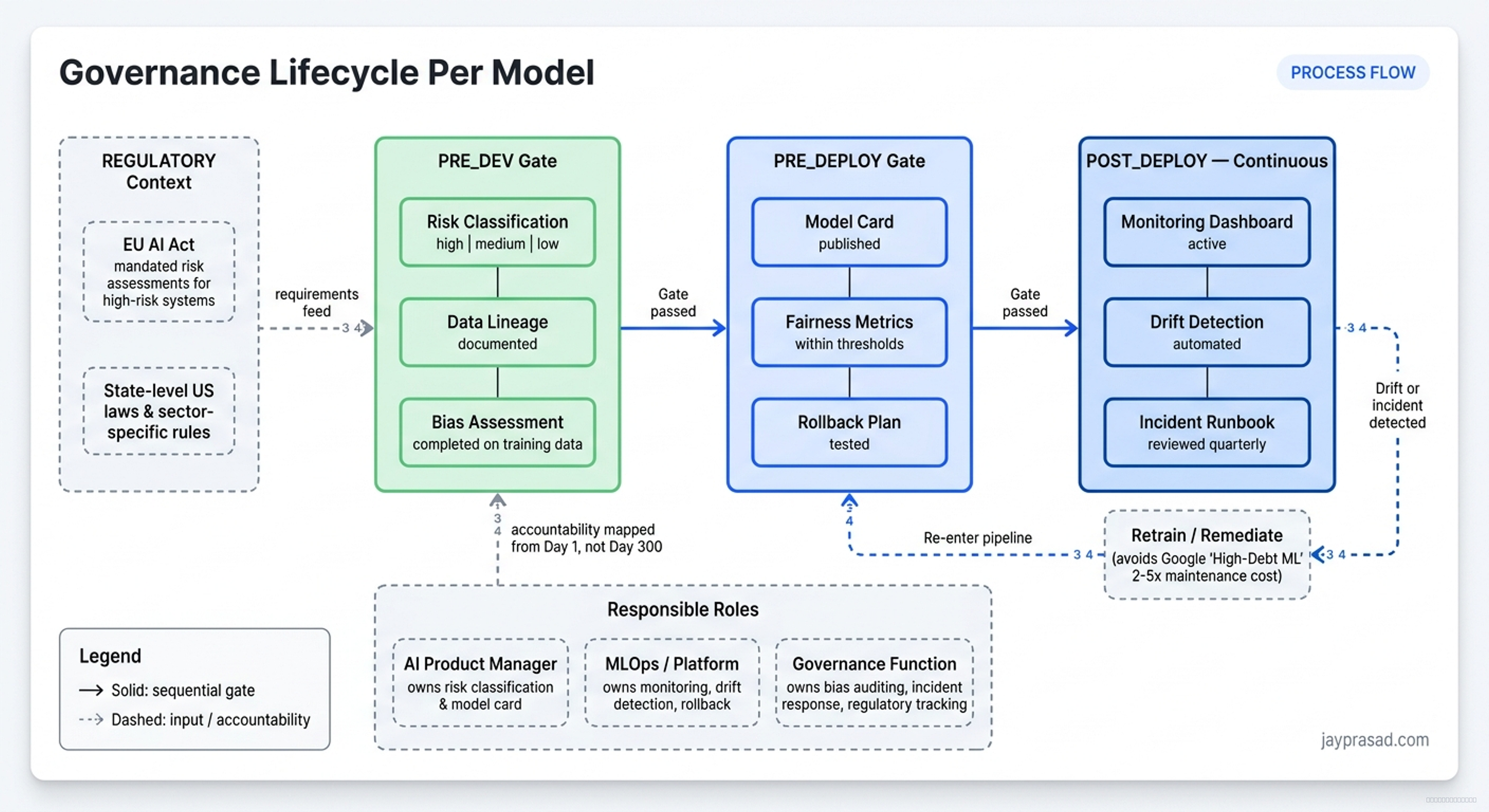
Governance From Day One, Not Day 300
The EU AI Act now mandates documented risk assessments for high-risk AI systems. This isn't optional. It requires dedicated organizational accountability.
Most teams bolt on governance after their first incident. That's like adding seatbelts after the crash.
What an AI Governance Function Actually Does
This isn't a compliance checkbox. It's an operational function:
- Risk classification — categorize every model by risk tier before development starts
- Bias and fairness auditing — run automated checks on training data and model outputs
- Documentation standards — maintain model cards, data sheets, and decision logs
- Incident response — define what happens when a model produces harmful outputs
- Regulatory tracking — monitor evolving requirements (EU AI Act, state-level US laws, sector-specific rules)
# Minimal AI Governance Checklist per Model
governance:
  pre_development:
    - risk_tier: "high | medium | low"
    - data_lineage: "documented"
    - bias_assessment: "completed"

  pre_deployment:
    - model_card: "published"
    - fairness_metrics: "within_thresholds"
    - rollback_plan: "tested"

  post_deployment:
    - monitoring_dashboard: "active"
    - drift_detection: "automated"
    - incident_runbook: "reviewed_quarterly"
Embedding this function from day one costs a fraction of retrofitting it later. It also builds trust with regulators, customers, and your own legal team.
---
The AI Team Design Blueprint: Sequencing Matters
Here's the sequencing that actually works. I've seen it succeed across mid-market and enterprise orgs.
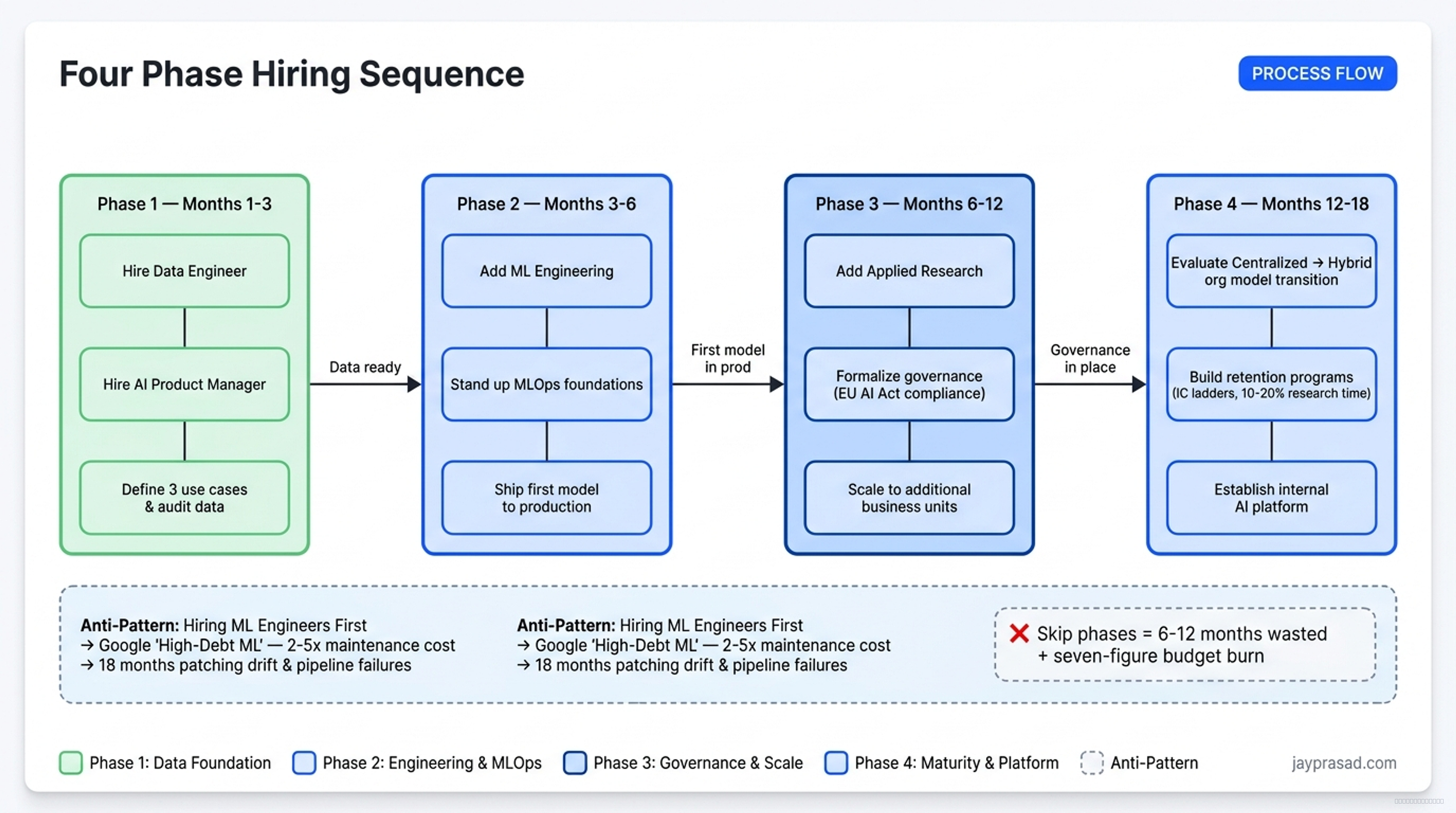
Phase 1 (Months 1-3): Hire a data engineer and an AI product manager. Define your first three use cases. Audit your data.
Phase 2 (Months 3-6): Add ML engineering. Stand up MLOps foundations. Ship your first model to production.
Phase 3 (Months 6-12): Add applied research. Formalize governance. Begin scaling to additional business units.
Phase 4 (Months 12-18): Evaluate org model transition (centralized → hybrid). Build retention programs. Establish internal AI platform.
The Readiness Checklist
Before you open your first AI headcount req, validate these:
- [ ] Three business-critical use cases identified and prioritized
- [ ] Data infrastructure assessed for AI readiness
- [ ] Capability stack mapped to use case requirements
- [ ] Org model selected with documented trade-offs
- [ ] Governance framework drafted (even if lightweight)
- [ ] Compensation bands benchmarked against current market
- [ ] Success metrics defined per capability layer
- [ ] Executive sponsor identified with budget authority
---
The Second-Order Consequence Nobody's Discussing
Here's what I think happens next. As AI agents become operational — executing tasks, making purchasing decisions, managing workflows — the AI team design question stops being about "how do we build models" and becomes "how do we govern autonomous systems."
The teams that got their capability stack right will adapt. They already have MLOps monitoring, governance frameworks, and AI PMs who understand system behavior. The teams that hired a bunch of ML engineers without structure? They'll be rebuilding from scratch.
The enterprise AI race isn't won by the team with the most PhDs. It's won by the team with the best blueprint.
Discussion
Responses, reactions, and open questions.
The article stays static. The conversation sits underneath it. Sign in with your email, react to the argument, and join the discussion.
Join the discussion
Use your email to get a one-time sign-in code. First comments may wait in moderation before they appear publicly.